BUY NOW

Support independent publishing: Buy this book on Lulu.
Εμφάνιση αναρτήσεων με ετικέτα Greek civilization. Εμφάνιση όλων των αναρτήσεων

Παρασκευή 17 Οκτωβρίου 2025

Agostino di Duccio and GREEK CONNECTION

Agostino di Duccio and GREEK CONNECTION

Agostino di Duccio (1418 – c.1481) - Archangel Gabriel, detail, 1470s, painted terracotta, Museum of Fine Arts, Budapest


Τα έργα του Agostino di Duccio παρουσιάζουν μια ισχυρή σύνδεση με την αρχαία ελληνική τέχνη μέσω της χρήσης κλασικών μορφών και μοτίβων, ιδιαίτερα στη γλυπτική διακόσμηση του Tempio Malatestiano στο Ρίμινι. Το ξεχωριστό γραμμικό του στυλ επηρεάστηκε από την ελληνιστική τέχνη, μια περίοδο της ελληνικής τέχνης γνωστή για το κλασικό νεοαττικό της στυλ. Παραδείγματα αυτής της ελληνικής σύνδεσης περιλαμβάνουν τη χρήση μιας μορφής σε άρμα από ένα ελληνικό νόμισμα από τις Συρακούσες σε ένα μενταγιόν σε ανάγλυφο και την ενσωμάτωση δάφνινων στεφάνων, συμβόλου νίκης στην αρχαία Ελλάδα.

Έμπνευση από την Κλασική Γλυπτική

Ελληνιστική Επιρροή: Η στυλιστική απόκλιση του Duccio από τους Φλωρεντινούς συγχρόνους του είχε τις ρίζες της στο νεοαττικό στυλ της ελληνιστικής τέχνης.

Κλασικές Μορφές: Τα έργα του παρουσιάζουν κλασικά θέματα και μορφές, όπως η αναπαράσταση της Ελληνίδας θεάς Σελήνης (Ρωμαϊκή Σελήνη), η οποία απεικονίζεται στους τοίχους του Tempio Malatestiano.

Συγκεκριμένα Παραδείγματα Ελληνικών Συνδέσεων

Μοτίβο Νομίσματος: Ένα ανάγλυφο στο μουσείο V&A απεικονίζει μια μορφή σε άρμα σε ένα μενταγιόν, το οποίο προέρχεται από ένα ελληνικό νόμισμα από τις Συρακούσες.

Δάφνινο Στεφάνι: Το μοτίβο ενός δάφνινου στεφάνου που κρατάει ένας άγγελος στα ανάγλυφά του πιθανότατα παραπέμπει σε αρχαίες ελληνικές αναφορές στη νίκη, παρόμοια με τη χρήση του στο Tempio Malatestiano.

Αυτοκρατορικές Μορφές: Τα μαρμάρινα τόντι του που απεικονίζουν αυτοκρατορικές μορφές δείχνουν επίσης στυλιστικές και πολιτισμικές συνδέσεις με αρχαία ελληνικά και ρωμαϊκά νομισματικά υποδείγματα. 

Agostino di Duccio's works exhibit a strong connection to ancient Greek art through his use of classical forms and motifs, particularly in his sculptural decoration of the Tempio Malatestiano in Rimini. His distinctive linear style was influenced by Hellenistic art, a period of Greek art known for its classical neo-Attic style. Examples of this Greek connection include the use of a figure in a chariot from a Greek coin from Syracuse on a pendant in a relief and the incorporation of laurel wreaths, a symbol of victory in ancient Greece.

Inspiration from Classical Sculpture

Hellenistic Influence: Duccio's stylistic departure from his Florentine contemporaries was rooted in the neo-Attic style of Hellenistic art.

Classical Forms: His works feature classical themes and figures, such as the representation of the Greek goddess Selene (Roman Luna), who is portrayed on the walls of the Tempio Malatestiano.

Specific Examples of Greek Connections

Coin Motif: A relief in the V&A museum features a figure in a chariot on a pendant, which derives from a Greek coin from Syracuse.

Laurel Wreath: The motif of a laurel wreath held by an angel in his reliefs likely alludes to ancient Greek allusions to victory, similar to its use in the Tempio Malatestiano.

Imperial Figures: His marble tondi depicting imperial figures also show stylistic and cultural connections to ancient Greek and Roman numismatic models.


Τα γλυπτά του Agostino di Duccio παρουσιάζουν ελληνιστικές επιρροές, ιδιαίτερα το νεοαττικό στυλ, το οποίο εκδηλώνεται στις χαρακτηριστικές γραμμικές μορφές του και στην έμφαση στις διακοσμητικές επιφανειακές επεξεργασίες αντί για τον αυστηρό νατουραλισμό. Αυτή η σύνδεση είναι εμφανής στις ελικοειδείς κουρτίνες και τα διακοσμητικά ανάγλυφα του Tempio Malatestiano στο Ρίμινι, όπου οι μορφές του, αν και κάπως αντικλασικές, δείχνουν σαφή χρέος στην αρχαία ρωμαϊκή και ελληνιστική τέχνη. Τα έργα του, όπως τα ανάγλυφα στην πρόσοψη του Ορατορίου του Αγίου Μπερναρντίνο στην Περούτζια, επιδεικνύουν επίσης μια παρόμοια στυλιζαρισμένη και γραμμική προσέγγιση, θυμίζοντας μοτίβα που βρίσκονται σε ρωμαϊκές σαρκοφάγους.

Ελληνιστικό Στυλ στο Έργο του Agostino di Duccio

Νεοαττικό Στυλ: Το έργο του Duccio αντλεί έμπνευση από το ύστερο ελληνιστικό νεοαττικό στυλ της κλασικής αρχαιότητας, ένα στυλ γνωστό για τη γραμμική αισθητική και διακοσμητικό του χαρακτήρα.

Γραμμική Έμφαση: Το ιδιαίτερο γραμμικό του στυλ, που χαρακτηρίζεται από ελικοειδείς και ρέουσες γραμμές, αποτελεί άμεση αντανάκλαση αυτής της κλασικής έμπνευσης.

Διακόσμηση Επιφάνειας: Η εστίαση του Duccio στην επίτευξη πολύτιμων επιφανειών μέσω διακοσμητικών και παιχνιδιάρικων πτυχώσεων των υφασμάτων αποτελεί χαρακτηριστικό γνώρισμα αυτής της ελληνιστικής επιρροής.

Στυλιζόμενες Μορφές: Αντί για νατουραλισμό, οι μορφές του εμφανίζονται συχνά επίπεδες, σχηματικές και αντικλασικές, όπως φαίνεται στα ανάγλυφα του Tempio Malatestiano.

Παραδείγματα στη Γλυπτική του

Tempio Malatestiano (Ρίμινι): Αυτό το αρχιτεκτονικό έργο περιλαμβάνει πολλά ανάγλυφα, συμπεριλαμβανομένων μορφών αγγέλων, των Πλανητών και των Ελευθέρων Τεχνών, τα οποία επηρεάζονται έντονα από το νεοαττικό στυλ.

Οροτόριο του Αγίου Μπερναρντίνο (Περούτζια): Τα ανάγλυφα εδώ, με τις στυλιζαρισμένες μορφές τους και τα επαναλαμβανόμενα μοτίβα, δείχνουν μια σαφή σύνδεση με την αρχαία ρωμαϊκή τέχνη, ιδιαίτερα με τις συνθέσεις σε σαρκοφάγους.

Codex Pighianus: Το μοτίβο των σαρκοφάγων της Μήδειας, ενός ενδύματος που φουσκώνει σφαιρικά, ένα συγκεκριμένο παράδειγμα από μια κλασική πηγή, εμφανίζεται στα ανάγλυφα του Duccio στην Περούτζια.

Πολιτιστικό Πλαίσιο

Ανθρωπιστικό Περιβάλλον: Οι ελληνιστικοί τρόποι χειρισμού του Duccio ήταν προϊόν του ανθρωπιστικού περιβάλλοντος του Ρίμινι, το οποίο ενθάρρυνε μια βαθύτερη ενασχόληση με τις κλασικές μορφές και ιδέες.

Αντιπαραβολή στην Αρχιτεκτονική: Το διακοσμητικό, ρέον γλυπτικό του στυλ έρχεται σε έντονη αντίθεση με τον «σκληρό και αυστηρά ρωμαϊκό διανοουμενισμό» της αρχιτεκτονικής του Alberti στο Tempio Malatestiano, αναδεικνύοντας τη μοναδική στυλιστική του προσέγγιση στο πλαίσιο της Αναγέννησης.                                                                                                                                                

Agostino di Duccio's sculptures exhibit Hellenistic influence, particularly its Neo-Attic style, which manifests in his characteristic lineal forms and emphasis on decorative surface treatments rather than strict naturalism. This connection is evident in the sinuous drapery and decorative reliefs of the Tempio Malatestiano in Rimini, where his figures, though somewhat anticlassical, show a clear debt to ancient Roman and Hellenistic art. His works, such as the reliefs on the facade of the Oratory of S. Bernardino in Perugia, also demonstrate a similar stylized and linear approach, recalling motifs found on Roman sarcophagi.

Hellenistic Style in Agostino di Duccio's Work

Neo-Attic Style: Duccio's work draws inspiration from the late Hellenistic Neo-Attic style of classical antiquity, a style known for its linear aesthetic and decorative character.

Linear Emphasis: His distinctive lineal style, characterized by sinuous and flowing lines, is a direct reflection of this classical inspiration.

Surface Decoration: Duccio's focus on achieving precious surfaces through decorative and playful pleating of drapery is a hallmark of this Hellenistic influence.

Stylized Figures: Rather than naturalism, his figures often appear flat, schematic, and anticlassical, as seen in the Tempio Malatestiano reliefs.

Examples in His Sculpture

Tempio Malatestiano (Rimini): This architectural project features numerous reliefs, including figures of angels, the Planets, and the Liberal Arts, which are heavily influenced by the Neo-Attic style.

Oratory of S. Bernardino (Perugia): The reliefs here, with their stylized forms and recurring motifs, show a clear connection to ancient Roman art, particularly compositions on sarcophagi.

Codex Pighianus: The Medea sarcophagi motif of a garment billowing out spherically, a specific example from a classical source, appears in Duccio's reliefs at Perugia.

Cultural Context

Humanist Environment: Duccio's Hellenistic mannerisms were a product of the Humanist environment of Rimini, which encouraged a deeper engagement with classical forms and ideas.

Contrasting Architecture: His decorative, flowing sculptural style stands in marked contrast to the "hard and severely Roman intellectualism" of Alberti's architecture at the Tempio Malatestiano, highlighting his unique stylistic approach within the Renaissance context.

Πέμπτη 16 Οκτωβρίου 2025

Piero della Francesca and GREEK CONNECTION

Piero della Francesca and Greek connection


Venetia Georgiou

Το "δίπτυχο του Δούκα του Ούρμπινο" (1465-περ.1475), είναι ένα από τα πιο διάσημα έργα της ιταλικής Αναγέννησης, ζωγραφισμένο τον μεγάλο καλλιτέχνη Piero della Francesca (1415-1492), πρώτο εκπρόσωπο της Κουατροτσέντο- Αναγέννησης και ουμανιστική ιδιοφυΐα . Απεικονίζει το ζεύγος Federico da Montefeltro (1422-1482) και της Battista Sforza (1446-1472) .
Τα πορτρέτα αποτελούσαν ένα δίπτυχο που άνοιγε σαν βιβλίο. Σήμερα, τα δύο έργα, είναι τοποθετημένα σε κοινή κορνίζα και ατενίζουν το ένα το άλλο στο μουσείο Uffizi, στην Φλωρεντία.
Ο  Ιταλός ζωγράφος της πρώιμης Αναγέννησης Piero della Francesca, που ήταν επίσης γνωστός στους συγχρόνους του και ως μαθηματικός-γεωμέτρης, με το ορθολογιστικό αλλά και σχεδόν μεταφυσικό ύφος του, έρχεται στην εκπροσώπηση του τέλειου ανθρώπου της Αναγέννησης, με την κεντρικότητα του ρόλου του στο σύμπαν και την υπεροχή της νοημοσύνης και του πολιτισμού του. Η χρήση της προοπτικής και του συμβολισμού από μέρους του επηρέασε πολλούς καλλιτέχνες που ακολούθησαν τα βήματά του. Αυτό το Δίπτυχο, ειδικότερα, αποτελεί απόδειξη της καλλιτεχνικής του δεινότητας και της ικανότητάς του να αποτυπώνει την ουσία των θεμάτων του. Η πρώιμη τέχνη της Αναγέννησης, αν και εμπνεύστηκε από τους Έλληνες και τους Ρωμαίους, είχε πολύ πιο φυσιοκρατική άποψη, σε σύγκριση με την ελληνική και ρωμαϊκή τέχνη.
 Ένα παράδειγμα αυτού είναι αυτό το δίπτυχο πορτρέτων του Piero della Francesca του 1447. Ο άντρας σε αυτόν τον πίνακα φαίνεται λίγο περίεργος, επειδή ένα μέρος της μύτης του είναι κομμένο. Ο Δούκας  ήταν παραμορφωμένος στη δεξιά πλευρά, επειδή έχασε τη ρινική γέφυρα και το δεξί μάτι του σε ένα ατύχημα σε τουρνουά ιπποδρομιών. Και για το λόγο αυτό απεικονίζεται από την αριστερή πλευρά του προσώπου. Ήθελε να τον ζωγραφίσουν όπως πραγματικά φαινόταν, χωρίς βέβαια το αντιαισθητικό ψεγάδι της δεξιάς πλευράς. Οι άνθρωποι άρχιζαν να βάζουν καλλιτέχνες να ζωγραφίζουν το πορτρέτο τους όπως ήταν στην πραγματική ζωή, αντί να δημιουργούν μια μη ρεαλιστική και ιδεαλιστική εικόνα του ατόμου.  Προφανώς η έννοια της "καλής μου πλευράς", τής πιο ωραίας, αλλά όχι ωραιοποιημένης, υιοθετήθηκε ήδη από τον 15ο αιώνα. Το κόκκινο κάλυμμα της κεφαλής του τον χαρακτηρίζει ως "Dux", μια σύνθεση μεταξύ του καλύμματος τού φλωρεντινού ευγενούς,  του Δόγη τής Βενετίας και του τουρμπανίου των βυζαντινών τετραρχών. Ενός συμβόλου δύναμης, κυριαρχίας. Αφού στη Ρώμη ήταν το χρώμα των στρατηγών, των ευγενών, των πατρικίων και κατά συνέπεια έγινε το χρώμα των Αυτοκρατόρων.  Η Αναγέννηση οικειοποιήθηκε τα σύμβολα της Ρωμαϊκής Αυτοκρατορίας και τα απένειμε στους άρχοντες τού 15ου αι. Αξίζει να παρατηρήσουμε και τη θέση των κεφαλιών τους σε σχέση με το τοπίο. Αυτό έχει επίσης ως στόχο να δείξει δύναμη και κύρος, καθώς υψώνονται σαν πύργοι στον ουρανό πάνω από την ύπαιθρο του Ουρμπίνο. Τα τοπία αναγνωρίζονται από τους μελετητές ως απεικονίσεις πανοραμικές και "φωτογραφικές" τής κοιλάδας τού ποταμού Μεταύρου. Είναι σαν να στέκονται στο παράθυρο του Δουκικού Παλατιού τους με θέα την επικράτειά τους, αυτούς τους απέραντους χώρους  - ένα σύμβολο δύναμης που εκτείνεται μέχρι εκεί που φτάνει το μάτι - τα προφίλ τους ξεχωρίζουν, πολύ κοντά και καθαρά, αλλά το ίδιο καθαρές είναι και οι λεπτομέρειες στο τοπίο, μέχρι τα μικρά πλεούμενα.
Η δούκισσα φαίνεται πολύ χλωμή στο στυλ της εποχής, δεν είναι σίγουρο αν αυτό οφειλόταν σε μια μικρή επιπλέον λεύκανση από το μακιγιάζ τής μόδας τής εποχής, ή στο έξυπνο χέρι τού καλλιτέχνη. Πέθανε πρόωρα σε ηλικία 26 ετών λόγω τοκετού, πριν ολοκληρωθεί το πορτρέτο, κάτι που βοήθησε επίσης στη διατήρηση της μνήμης της.
Στην πίσω πλευρά του Διπτύχου, (3η εικόνα), δυο άλλες  παραστάσεις με το ζεύγος σε ένα θέμα αγαπητό για να τους ανθρωπιστές, επειδή υπενθύμιζε τον κόσμο της αρχαίας Ρώμης και ήταν γεμάτο από λογοτεχνικές επιρροές που προέρχονται από τα έργα του Πετράρχη. Είναι ο Θρίαμβος του Δούκα Federico da Montefeltro και τής Battista Sforza, (τέμπερα σε ξύλο) .
 Ο Δούκας (λεπτομέρεια, 2η εικόνα) κάθεται σε άρμα που το σέρνουν δυο λευκά άλογα ως πορτρέτο-ηγέτης με την πανοπλία του, ενώ τον στεφανώνει με δάφνες μια νίκη,  Μπροστά απ' αυτόν κάθονται οι τέσσερις βασικές αρετές: η Δικαιοσύνη (κατά μέτωπο, με το σπαθί και στη σκάλα), η Σύνεση (σε προφίλ, με καθρέφτη), η Άμυνα- φρούριο (με την σπασμένη στήλη) και η Εγκράτεια (από πίσω). Ένας ερωτιδέας καθοδηγεί τα άλογα.  Η επιγραφή στην Λατινική με κεφαλαία γράμματα, εκθειάζει τις αρετές του ηγεμόνα. 
Η Βattista (λεπτομέρεια, 4η εικόνα) είναι σε άρμα που το σέρνουν δυο μονόκεροι, σύμβολα της αγνότητας, συνοδευόμενη από τις τρεις θεολογικές αρετές: τη Φιλανθρωπία (ντυμένη στα μαύρα με τον πελεκάνο στην κοιλιά της, ένα σύμβολο της μητέρας -θυσίας που τρυπά το σώμα της και δίνει το ίδιο το αίμα της για την επιβίωση των παιδιών της), την Πίστη (ντυμένη στα κόκκινα με το Δισκοπότηρο και το σκήπτρο) και την Ελπίδα και την Τέχνη από πίσω της, τονίζοντας και τον ρόλο της ως προστάτιδας των τεχνών (αφού ο οίκος Sforza ήταν γνωστός για την αγάπη του στις τέχνες).  Ένας ερωτιδέας οδηγεί. Η επιγραφή εξυψώνει τις αρετές της συζύγου σπουδαίου ανδρός που εξαίρουν οι έπαινοι.


Piero della Francesca had a significant Greek connection through his profound study and application of ancient Greek mathematics and geometry, particularly Euclid, which he incorporated into his art and writings on perspective and proportion. He was also knowledgeable about Greek philosophy, such as the work of Plato, and showed interest in classical Roman architecture. His scientific and philosophical treatises, like On Perspective and On the Five Regular Bodies, directly referenced Greek geometric principles and were based on classical knowledge, positioning him as a key figure in reviving Greek geometry in the 15th-century Renaissance.
Mathematical & Geometric Foundations
Euclid and Geometry: Piero's mastery of Greek geometry, including Euclid's Elements, formed the basis for his groundbreaking treatise De prospectiva pingendi (On Perspective in Painting).
Archimedes and Solids: He also engaged with the work of Archimedes, copying his Opera and writing Libellus de quinque corporibus regularibus (On the Five Regular Bodies), which explored Platonic solids.
Revival of Classical Thought: His intellectual work was a cornerstone in the 15th-century revival of Greek geometry and mathematics in Europe, placing him among the few contemporaries with such extensive knowledge.
Philosophical & Artistic Applications
Platonic Ideals: His work drew on Platonic ideals regarding proportion and the fundamental structures of the universe, as seen in the concept of the five regular polyhedra.
Classical Roman Influence: His interest in classical Roman architecture, along with Greek geometry, developed after his visits to Rome, further solidifying his connection to antiquity.
Intellectual Output & Legacy
De prospectiva pingendi: This treatise on perspective, dedicated to his patron Federico da Montefeltro, is a prime example of applying Greek geometry to painting and art.
Libellus de quinque corporibus regularibus: This second major work reflects his deep understanding of Greek geometrical problems and is a testament to his interest in classical philosophical concepts of perfect forms.
The Ideal Geometer-Painter: Piero became known as the "geometer-painter" for his successful fusion of mathematical rigor and artistic skill, a practice that made his work unique and influential.

Françoise Malraux
Piero della Francesca, who spoke fluent Latin, based his theories on Euclid's (325 BC-265 BC) Elements, thirteen books in which the Greek mathematician summarized all the by then known geometric knowledge. His Regular Bodies corresponded to what Plato in his dialogue Timaeus had described as the convex polyhedra which, according to him, constituted the basic structures of the Universe. Euclid, who was Plato's student, proved by a variety of mathematical calculations that there are only five such basic polyhedra. In alchemy, well known among Renaissance artists who mixed their own colours, Plato's bodies corresponded to the four classical elements, which in turn comprised a fifth structure – the Dodecahedron.
https://www.in-spite-of-it-all-trots-allt.se/news/birth-of-the-renaissance-thoughts-caused-by-piero-della-francesca/?fbclid=IwY2xjawM96JFleHRuA2FlbQIxMABicmlkETB3enVFUTN1ZzFsd211ZDFhAR6Vi1U3UI2B9QgY5dUBFeeXkK2jy7DEA0JM02W8WmSmdY_SdBhvCUMQvEPj9A_aem_XPBhBUCkwB6e1kQkFyAm0A


Vladimiro Valerio. 2011. "Piero della Francesca’s Sky in The Dream of Constantine," The Inspiration of Astronomical Phenomena VI
https://www.academia.edu/4500813/Piero_della_Francesca_s_Sky_in_The_Dream_of_Constantine?fbclid=IwY2xjawM96NRleHRuA2FlbQIxMABicmlkETB3enVFUTN1ZzFsd211ZDFhAR4lCvBs5A8GA40kfFPJXi2UFxYMkeE8S8FYU8ip8aYQzEPrHf01ALOCMq9S2w_aem_tIcRtRmWRwGwBJvZYLTS2Q

The paper analyzes Piero della Francesca's depiction of the starry sky in the fresco The Dream of Constantine. It explores the characteristics of the stars portrayed, their correspondence to real celestial patterns, and historical context, revealing how the artwork reflects an inversion of typical sky representation as observed in ancient Greek astronomy. The work draws connections between Piero's artistic choices and earlier astronomical depictions, and discusses their implications for understanding perspective in art.


In his 1951 book, Piero Della Francesca, art historian Kenneth Clark identified the bearded figure as a Greek scholar and the painting as an allegory of the suffering of the Church after the fall of the Byzantine Empire in 1453. The painting also commemorates one of the Councils held after, possibly the Council of Mantua (1459). Clark stated that to date all attempts to explain the center figure or portrait on the right had been unsuccessful.[7] Again, the man in the far left would be the Byzantine Emperor.


May be an image of 7 people
2h
Reply
Françoise Malraux
The Geometry of Time, After Piero della Francesca (a fiction)
Paul Kahn
https://medium.com/@pauldavidkahn/the-geometry-of-time-after-piero-della-francesca-a-fiction-15e34f50b522

The Geometry of Time, After Piero della Francesca (a fiction)
MEDIUM.COM
The Geometry of Time, After Piero della Francesca (a fiction)
2h
Reply
Remove Preview

Δευτέρα 25 Μαρτίου 2024

WAITING FOR GODOT..

ΠΕΡΙΜΕΝΟΝΤΑΣ ΤΟΝ ΓΚΟΝΤΟ (ή Ο BECKETT & Η ΜΕΙΖΩΝ ΕΛΛΑΣ) - ΕΡΑΝΙΣΜΑΤΑ

A student production of "Waiting for Godot".jpg (Wikipedia Commons)

Waiting for Godot by Samuel Beckett (Theodoros Terzopoulos, Onassis Stegi)


Mind, Language and Thinking in Samuel Beckett's Waiting for Godot (Singh 2023)

Αυτό το άρθρο υποστηρίζει ότι το μυαλό, η γλώσσα και η σκέψη έχουν τριγωνική σχέση. Εγείρει ένα ζήτημα εάν η γλώσσα είναι απαραίτητη στην διαδικασία της σκέψεως. Είναι πολύ συζητήσιμο το αν η γλώσσα και η σκέψη είναι αλληλεξαρτώμενα ή ανεξάρτητα στοιχεία. Ο ρόλος του νου πρέπει να είναι σημαντικός στη διαδικασία της σκέψεως. Η γλώσσα είναι εργαλείο σκέψεως. Αυτό το τριγωνικό ζήτημα του μυαλού, της γλώσσας και της σκέψης έχει τεθεί στη σκηνή όταν ο Lucky, στο έργο του Samuel Beckett Waiting for Godot, κάθεται και σκέφτεται. Η σκέψη του Lucky μας εμπνέει να εξερευνήσουμε το τριγωνικό ζήτημα. Μετά από ανάλυση των δεδομένων και της γλώσσας που χρησιμοποιείται στην σκέψη από τον Lucky, ανακαλύπτεται ότι το μυαλό είναι καταλύτης και η γλώσσα και οι σκέψεις είναι ουσίες στο μυαλό. Η υπόθεση του Benjamin Lee Whorf αναφέρει ότι η επίδραση της γλώσσας στην σκέψη είναι υποχρεωτική. Ο Oscar Wilde παρατηρεί ότι η γλώσσα είναι ο γονέας, και όχι το παιδί, της σκέψεως. Ο Bertrand Russell ισχυρίζεται ότι ο ρόλος της γλώσσας είναι να κάνει δυνατές σκέψεις που δεν μπορούν να υπάρξουν χωρίς αυτήν, αλλά η επεξεργασία είναι στο μυαλό ως εσωτερικός ή νοητικός λόγος. Η γλώσσα επηρεάζει την νόησή μας και, ως εκ τούτου, τις σκέψεις μας.                                        

This paper claims that mind, language and thinking have triangular relationship. It raises an issue whether language is necessary in the process of thinking. It is very debatable issue whether language and thinking are interdependent or independent elements. Role of the mind must be significant in the process of thinking. Language is a tool for thinking. This triangular issue of mind, language and thinking has been brought into the scene when Lucky, in Samuel Beckett’s play Waiting for Godot, is sitting and thinking. Lucky’s thinking inspires us to explore the triangular issue. After analysis of the data and the language used in thinking by Lucky, it is discovered that mind is a catalyst and language and thoughts are substances in the mind. Benjamin Lee Whorf's hypothesis states that the influence of language on thinking is obligatory. Oscar Wilde remarks that language is the parent, and not the child, of thought. Bertrand Russell claims the role of language is to make possible thoughts which cannot exist without it but processing is in the mind as inner or mental speech. Language influences our thinking and, thereby, our thoughts. 

Traces of Greek Mythology in Samuel Beckett’s Waiting for Godot (Ravari 2010)

Αυτή η μελέτη πραγματεύεται το πιο διάσημο έργο του Σάμιουελ Μπέκετ, το 'Περιμένοντας τον Γκοντό', σε μια προσπάθεια να αναλύσει τους χαρακτήρες του από μια μυθιστορηματική οπτική. Δεδομένου ότι η ελληνική μυθολογία έχει αδιαμφισβήτητα επιρροή στη δυτική κουλτούρα και λογοτεχνία, ο ερευνητής επιχειρεί να διερευνήσει τη σύνδεση μεταξύ της ελληνικής μυθολογίας και του θεατρικού έργου. Αυτή η μελέτη στοχεύει να αποκαλύψει ότι ακόμη και μετά από περισσότερα από πενήντα επτά χρόνια συγγραφής κριτικών, αναλύσεων, ερμηνειών και κριτικών για το Waiting for Godot του Beckett, υπάρχουν ακόμη κάποια νέα σημεία σε αυτό το αριστούργημα που δεν έχουν αναλυθεί. Ο Γκοντό μπορεί να ερμηνευθεί ως Δίας, ο Πότζο ως ο μεταμφιεσμένος Δίας, ο Λάκι και το αγόρι ως Άτλας και Ερμής, και τέλος ο Βλαντιμίρ και ο Εστραγκόν ως τα ανθρώπινα όντα που ζούσαν στα τελευταία χρόνια της Χρυσής Εποχής. Αν και ο Μπέκετ δεν έχει αποφανθεί άμεσα ότι επηρεάζεται από την Ελληνική Μυθολογία, ίχνη μυθολογικών χαρακτήρων, όπως ο ερευνητής τα εξετάζει, φαίνονται στο Waiting for Godot. 

This study addresses Samuel Beckett’s most celebrated play, Waiting for Godot, in an effort to analyze its characters from a novel perspective. Since Greek mythology has been undisputedly influential on Western culture and literature, the researcher attempts to investigate a connection between Greek mythology and the play. This study aims to reveal that even after more than fifty seven years of writing criticisms, analyses, interpretations, and reviews on Beckett’s Waiting for Godot there are still some new points in this masterpiece that have not been found. Godot can be interpreted as Zeus, Pozzo as the disguised Zeus, Lucky and the Boy as Atlas and Hermes, and finally Vladimir and Estragon as the human beings living in the last years of the Golden Age. Although Beckett has not directly pronounced to be influenced by Greek Mythology, traces of mythological characters, as the researcher examines, are seen in Waiting for Godot. 
SOURCE: Ali Ravari. 2010. "Traces of Greek Mythology in Samuel Beckett’s Waiting for Godot," Journal of Applied Language Studies (JALS) 1 (2), pp. 51-67. https://rals.scu.ac.ir/article_10422...

Ψάχνοντας Ελληνικές αναφορές για το έργο Περιμένοντας τον Godot

Ψάχνοντας για σχόλια και πληροφορίες σχετικές με το περίφημο έργο "Περιμένοντας τον Godot" και τα τυχόν υπάρχοντα Ελληνικά στοιχεία του ανακάλυψα δύο αναφορές στο έργο από 'Ελληνοφώνους': η πρώτη από το Εργαστήριο Έρευνας Aφηγήσεως (ή μάλλον Laboratory of Narrative Research όπως αναφέρεται στην Αγγλόφωνη ιστοσελίδα!) του ΑΠΘ (https://www.new.enl.auth.gr/lnr/waiting-for-godot/#bwg3/13){https://www.new.enl.auth.gr/lnr/waiting-for-godot/?fbclid=IwAR23zFC-JSguQqoFbaT421N0X-9vtrKoMd3QbeMd23KbJ5jH9mmSlImnG6g#bwg3/13} και η δεύτερη από το ανέβασμα του έργου στην Στέγη από τον εξαίρετο Τερζόπουλο (https://www.onassis.org/whats-on/waiting-for-godot-by-samuel-beckett-theodoros-terzopoulos?fbclid=IwAR1zVE93CW0FSg5xoIYvELzYC7DLABAIqiOapDJciqIAntjoHri6-tEVq-E) .. ΠΟΥΘΕΝΑ ΔΕΝ ΕΙΔΑ ΑΝΑΦΟΡΑ ΣΤΑ ΕΛΛΗΝΙΚΑ ΣΤΟΙΧΕΙΑ ΤΟΥ ΕΡΓΟΥ! (ΟΠΕΡ ΚΑΙ ΑΝΑΜΕΝΟΜΕΝΟ ΑΠΟ ΤΗΝ ΧΩΡΑ ΤΩΝ ΣΥΓΧΡΟΝΩΝ ΨΟΦΟΔΕΩΝ 'ΓΙΟΥΝΑΝΩΝ').

Godot and the Great Concealer of Truth (Shawn Collins 2014)

The project uses Samuel Beckett’s 1954 play, Waiting for Godot, as the principle matrix of investigation in exploring the implementation of the pastoral genre in a postmodern text as a means of criticizing religion. The article explores the text’s use of the themes and characteristics found throughout the history of the pastoral tradition including shepherding, idleness, and the intentional passing of time. Godot draws heavily on the Judeo-Christian traditions and HELLENISTIC and Roman mythology (as well as Renaissance literature, eighteenth-century metaphysics, and Cartesian dualism) to implicate an illusory pastoral space in its criticism of religious practices.

A Critical Study of Beckett’s Waiting for Godot through the Lens of Post Modernism  ή ο God-ot ως Ζεύσο θεός Δίας! (Shibajyoti Karmakar 2014)

Αυτό το άρθρο εστιάζει στις διάφορες αναγνώσεις του μινιμαλιστικού θεατρικού έργου Περιμένοντας τον Γκοντό του Beckett έχοντας κατά νου τις διάφορες πτυχές του μεταμοντερνισμού και των βασικών χαρακτηριστικών του. Η ιδέα του Παραλόγου μεταφέρθηκε στο κεντρικό πλαίσιο μέσα από μια προσεκτική μελέτη του Μύθου του Σισύφου του Καμύ. Η κυκλική δομή του έργου ενισχύει περαιτέρω τις αφηρημένες ιδέες μεταξύ των χαρακτήρων. Κάθε χαρακτήρας έχει απομονωθεί από την σφαίρα του Χρόνου καθώς ασχολείται με ανόητη συζήτηση που δεν έχει κανένα νόημα. Η ιδέα της παρουσίας και απουσίας του Γκοντό έχει μελετηθεί συμβολικά προκειμένου να εισάγει τις μεταδομικές ιδέες στο έργο. Οι ιδέες Derrida περί αποδομήσεως (deconstruction) και το επιδραστικό δοκίμιο του Roland Barthes  The Death of the Author συνιστούν τις πρωταρχικές πηγές που έχουν διαβαστεί για να επιβεβαιωθεί ότι 
ο Beckett εμπίπτει στην κατηγορία του μεταδομικού κόσμου. Τα τυπικά χαρακτηριστικά του μεταμοντερνισμού, όπως ο κατακερματισμός, το παράδοξο, το παιχνίδι λέξεων και τα τυπικά δυαδικά αρχεία έχουν ερμηνευτεί διεξοδικά στο πλαίσιο του έργου. Το πνευματικό κενό και η πολιτισμική επιπολαιότητα παίζει μείζονα ρόλο στην αποδόμηση κάθε προ-υποτιθέμενης αλήθειας και μας εισάγει στον μπεκετιανό κόσμο της αποδομήσεως.
..
Υπάρχει επίσης μια αναφορά σε έναν χαρακτήρα που ονομάζεται Godeau σε έργο του Balzac. Ο Godot μπορεί να είναι ο απρόσιτος Θεός, ο θάνατος, ένα είδος μελλοντικής ουτοπίας, ή η πανάκεια της τροφής και της στέγης. Μπορεί να είναι το σύμβολο ελπίδας του απλού Γάλλου πολίτη υπό γερμανική αιχμαλωσία. Μπορεί να είναι το υπερθετικό πλάσμα που είναι σε θέση να σώσει ή να τιμωρήσει τους δύο πρωταγωνιστές. Στην ελληνική μυθολογία, ο Ζεύς ήταν ο ανώτατος ηγέτης των ελληνικών θεοτήτων και ήταν γνωστός ως Jupiter ή Jove από τους Ρωμαίους. Κατέλαβε τον θρόνο του κόσμου επαναστατώντας εναντίον του πατέρα του, του Κρόνου, σε έναν πόλεμο που ονομάζεται Τιτανομαχία. Ο Δίας εν συνεχεία ίδρυσε το ανάκτορό του στην κορυφή του Ολύμπου, το υψηλότερο βουνό της Ελλάδας, που βρίσκεται στα όρια Θεσσαλίας και Μακεδονίας. Ως κυβερνήτης του Σύμπαντος, ο Δίας δεν ανέχεται καμία παράβαση και τιμωρεί τους παραβάτες του αδυσώπητα και χωρίς διακρίσεις. Η κύρια ομοιότητα μεταξύ του Δία και του Godot είναι ότι διεκδικούν την θέση της απόλυτης εξουσίας. Αυτό συνιστά έναν από τους σημαντικούς παράγοντες της ερμηνεία γιατί και ο Ζεύς και ο Godot ανήκουν στο υπερθετικό καθώς φαίνονται κυριολεκτικά παρά τη φυσική τους απουσία στο έργο. Ωστόσο, ο Beckett δεν βοηθάει πολύ στην ανεύρεση της τελικής απαντήσεως στο ερώτημα για το ποιος ή τι είναι ο Godot. Κάποτε σε μια συνέντευξη είπε: «Αν ήξερα, θα το έλεγα στο έργο». Ο συγγραφέας δεν προσφέρει σαφήνεια αποδόσεως & ταυτοποιήσεως. Παρέχει επομένως υπαινιγμούς για την πληθύ και την πολλαπλότητα των κειμένων. Ο συγγραφέας έχει θεωρηθεί ως υποκείμενος σε πολλές επιρροές για την συγγραφή του έργου..

Traces of Greek Mythology in Samuel Beckett’s Waiting for Godot (Ali Ravari)

Αυτή η μελέτη πραγματεύεται το πιο διάσημο έργο του Samuel Beckett, το Waiting for Godot, σε μια προσπάθεια να αναλύσει τους χαρακτήρες του από μια μυθιστορηματική οπτική. Δεδομένου ότι η ελληνική μυθολογία έχει αδιαμφισβήτητα επιρροή στην δυτική κουλτούρα και λογοτεχνία, ο ερευνητής επιχειρεί να διερευνήσει μια σύνδεση μεταξύ της ελληνικής μυθολογίας και του θεατρικού έργου. Αυτή η μελέτη στοχεύει να αποκαλύψει ότι ακόμα και μετά από περισσότερα από πενήντα επτά χρόνια συγγραφής κριτικών, αναλύσεων, ερμηνειών και κριτικών για το Waiting for Godot του Beckett, εξακολουθούν να υπάρχουν μερικά νέα σημεία σε αυτό.
... αριστούργημα που δεν έχουν βρεθεί. Ο Godot μπορεί να ερμηνευθεί ως Δίας, ο Pozzo ως ο μεταμφιεσμένος Δίας, ο Lucky και το αγόρι ως Άτλαντας και Ερμής, και τέλος ο Vladimir και ο Estragon ως τα ανθρώπινα όντα που ζούσαν στα τελευταία χρόνια της Χρυσής Εποχής. Αν και ο Beckett δεν έχει αποφανθεί άμεσα ότι επηρεάζεται από την Ελληνική Μυθολογία, ίχνη μυθολογικών χαρακτήρων, όπως εξετάζει ο ερευνητής, φαίνονται στο Περιμένοντας τον Γκοντό.

For to End Yet Again with Sacrificial Rituals" (Tom Cousineau 2007)

Η παρούσα εργασία αναλύει με φόντο την ελληνική τραγωδία. Ερμηνεύω τον ομολογημένο στόχο του Μπέκετ να δημιουργήσει «μορφή σε κίνηση» στη δική του παραγωγή του έργου σε σχέση με τις ρυθμικές κινήσεις ενός ρεφρέν που αποτελούσαν κεντρικό χαρακτηριστικό της τραγωδίας. Βασιζόμενος στη μη θυσιαστική ερμηνεία της Σταύρωσης του Χριστού από τον René Girard, υποστηρίζω περαιτέρω ότι «τίποτα δεν συμβαίνει» στον Godot επειδή, σε αντίθεση με μια τραγωδία στην οποία η πανούκλα που έχει επιπέσει στην Θήβα μπορεί να αποδοθεί σε έναν καθορισμένο αποδιοπομπαίο τράγο, είναι ένα έργο στην οποία ο ανθρώπινος πόνος δεν μπορεί να ανακουφιστεί με την προσφυγή σε μαγικές λύσεις. 

Sophoclean Beckett in Performance (B. A. Spence)

ΣΟΦΟΚΛΕΙΟΣ BECKETT ΣΤΗΝ ΣΚΗΝΗ (ΕΝ ΠΑΡΑΣΤΑΣΕΙ) 
Ενώ οι καινοτομίες του Samuel Beckett για την σκηνή τον τοποθετούν στην πρωτοπορία του θεάτρου του τέλους του 20ού αιώνα, το χρέος του στο αρχαίο ελληνικό δράμα σπάνια συζητείται. Αυτό το άρθρο υποστηρίζει ότι η πιο πλούσια δέσμευση - συσχέτιση μεταξύ του θεάτρου του Beckett και της τραγωδίας και της κωμωδίας της αρχαίας Αθήνας φαίνεται στην παράσταση, δηλαδή στην φάση μετά την σύνθεση & δημοσίευση των έργων του. Ο σκηνοθετικός έλεγχος του Beckett δημιούργησε μια συνεχή διαδικασία συνθέσεως. Χρησιμοποιώντας τα στοιχεία των σημειώσεων παραγωγής του, καταδεικνύω πώς η παραστατική του αισθητική απηχεί τα γνωστά της ελληνικής πρακτικής και, ειδικότερα, πώς χρησιμοποιεί μιμητικά μιαν εκφραστική διήγηση, συνδυάζοντας την αφήγηση και την επίδειξη σε μια διαδικασία οπτικοποιήσεως. Το επιχείρημα απεικονίζεται μέσα από μια συγκριτική ανάλυση του Οιδίποδα Τυράννου του Σοφοκλέους και της ιστορίας της παραστάσεως του μονόπρακτου του Krapp με τίτλο Last Tape. Ενώ και τα δύο θεατρικά κείμενα περιλαμβάνουν μια κεντρική δραματική ανάληψη που πυροδοτεί την πραγματοποίηση ενός ακούσιου οιονεί νόστου, στην παράσταση το έργο του Beckett δίνει ολοένα και μεγαλύτερη έμφαση σε τέτοια Σοφόκλεια στοιχεία όπως μια περιγεγραμμένη Mise-en-scène {ΣτΜ: Mise en scène είναι η διάταξη σκηνικών και σκηνικών ιδιοτήτων σε ένα έργο. Μετάφραση από τα γαλλικά, σημαίνει «στήσιμο της σκηνής», αλλά, στην ανάλυση ταινιών, ο όρος mise en σκηνή αναφέρεται σε οτιδήποτε βρίσκεται μπροστά από την κάμερα, συμπεριλαμβανομένου του σκηνικού, του φωτισμού και των ηθοποιών. Η Mise-en-scène στην ταινία είναι η συνολική επίδραση του τρόπου με τον οποίον όλα συνδυάζονται για το κοινό}, συγκρατημένη σωματική κίνηση, εκφραστικό θέαμα και αυξημένη χρήση τόσον του χώρου εκτός σκηνής όσον και του απομακρυσμένου χώρου. Η υπογράμμιση αυτών των αντιστοιχιών είναι μια κοινή παρατακτική τροπικότητα, που αποδεικνύεται σε καίριες στιγμές στο επίπεδο της λέξεως (με αποτέλεσμα ουσιαστικές παύσεις και αντιπαραθέσεις στον διάλογο) καθώς και σε φαινομενολογικές πτυχές της παραστάσεως κάθε έργου. 


Electra traces: Beckett's critique of Sophoclean tragedy' (Drew Milne)

ΗΛΕΚΤΡΑ Σοφοκλέους: ὦ φάος ἁγνὸν καὶ γῆς ἰσόμοιρ᾿ ἀήρ, ὥς μοι ... 
WINNIE Beckett (Happy Days, II act): 'Hail, holy light.' 

Electra traces: Beckett's critique of Sophoclean tragedy'
'ΙΧΝΗ ΤΗΣ ΗΛΕΚΤΡΑΣ: Η ΑΠΟ ΜΕΡΟΥΣ ΤΟΥ BECKETT ΚΡΙΤΙΚΗ ΤΗΣ ΣΟΦΟΚΛΕΙΑΣ ΤΡΑΓΩΔΙΑΣ'
by Drew Milne
'WINNIE: One loses one's classics. [Pause] Oh not all. [Pause] A part. [Pause] A part remains. [Pause] That is what I find so wonderful, a part remains, of one's classics, to help one through the day.' Samuel Beckett, Happy Days, [1]
After the initial cries of Electra before her entrance, the opening line of Sophocles's Electra is: 'o phaos agnon', an expression most often translated as 'O holy light'.[2] The first words of Winnie in the second act of Beckett's play Happy Days are 'Hail, holy light.' (CDW: 160) At the risk of too violently forcing this comparison, what would it mean to hear a trace of Sophocles's Electra in Winnie's salutation, and to perceive in this trace a reflection on light as one of theatre's historically mutable conditions of possibility? There are many ways in which a comparison of Beckett's Winnie and Sophocles's Electra asks too much of the fragile resources available. At first blush it seems likely that any similarity in their salutations to light is more coincidental than intended, even if mediating layers of literary and theatrical translation could be construed. There is only slender evidence to suggest that Beckett sought to provoke such a comparison. Such slender evidence includes stray remarks indicating Beckett's familiarity with Greek tragedy, such as Beckett's letters to Alan Schneider, which refer to Oedipus Tyrannus as 'Swollen Feet' and summarise Sophocles's Philoctetes as 'all wound and moan.' [3] Perhaps the most explicit evidence of Beckett's interest in suggesting a critique of classical tragedy is his early play Eleutheria, which, along with its Greek title, includes a number of allusions, direct and indirect, to Sophocles.[4] Nevertheless, the terms of this argument are more speculative than philological. The suggestion is that the trace of Electra in Winnie's speech can be heard as an indication of the way Beckett's work develops a critique of modern drama's conditions of possibility. Through Beckett's critique of pure drama it becomes possible to suggest an attenuated critique of Sophoclean tragedy informing Beckett's conception of theatre. Problems suggested by Beckett's understanding of theatre also inform modern productions, such as Jane Montgomery's production of Sophocles's Electra, which contrast the classical text with the modern stage technologies of lighting, video projection and English surtitles.
Some sense of the terms of historical resonance involved can be suggested by contrasting some remarks on the meaning of Electra and technology which pre-date Beckett. Theodor Adorno, in his book Quasi una Fantasia, recalls the associations aroused in his childhood by Richard Strauss: 'To me the name of Strauss suggested music that was loud, dangerous and generally bright, rather like industry, or rather what I then imagined factories to look like.' [5] Within this identification of Strauss with modernity, Adorno continues: 'But more than all this my imagination was kindled by the word Elektra. This word was explosive and full of artificial, seductively evil smells, like a large chemical works close to the town where we lived, whose name sounded very similar. The word glittered cold and white, like electricity, after which it appeared to have been named...' [6] Strauss's opera Elektra takes its title from the libretto by Hugo von Hofsmannsthal based on Sophocles's play. The title of Strauss's opera resonates in Adorno's imaginative childhood as a beguiling pun which somehow yokes together the ancient name and modern industrial electricity. The juxtaposition of classical antiquity with industrial modernity is reminiscent of comments made by Karl Marx in the introduction to the Grundrisse: 'Is the view of nature and social relations on which the Greek imagination and hence Greek [mythology] is based possible with self-acting mule spindles and railways and locomotives and electrical telegraphs? What chance has Vulcan against Roberts & Co., Jupiter against the lightning-rod and Hermes against the Crédit Mobilier?' [7] The triumph of capitalist domination has been less one-sided than Marx imagines. Who now remembers Roberts & Co.? Indeed the roles are reversed in the Dialectic of Enlightenment, in which Adorno and Horkheimer reconfigure the encounter between Odysseus and the sirens as an allegory for modernity. [8] Capitalist production has also been surprisingly eager to appropriate mythological names, from Ajax's reduction to a domestic cleaning agent and Clio's ignominy as an automobile, to Nike's embarrassment as a just-doing-it sort of shoe. Some purveyor of electricity or electrical goods may yet chance upon Electra as a post-modern brand name, but the omens are not favourable. The power of Electra's name seems instead to generate a disturbing challenge to modern ears, a disturbance felt as a trace by the young Adorno. How, then, to understand the speculative pun that links Electra with electrons and electricity? In Quasi una Fantasia Adorno goes on to comment on his childhood reverie that: 'Only much later did I notice that the images generated by my imagination in advance of any knowledge actually fitted the music far better than the verification procedures I subsequently conducted.' [9] Such claims for the truth of imaginative insight over knowledge provoke scepticism, but if Adorno was right to hear a coincidence of ancient names and modern electricity in Strauss's music, the historical conditions for this analogy point to the importance of electricity for modern opera more generally.
What, indeed, would be the fate of modern opera were it not for the power of electric light? The dimming of house lights to generate the pool of religiosity associated with post-Wagnerian opera can be understood as a homage to electricity. Understood speculatively, then, Electra's salutation to holy light in the theatre of Dionysus is transformed in the history of theatre by the power of candles, tapers and torches, before the subsequent impact of more elaborate lighting technologies, such as the stage chandeliers of seventeenth-century theatre. [10] As Glynne Wickham suggests, 'It can be argued that most of the major changes that overtook the theatre during the nineteenth century owed more to engineers - civil, mechanical and optical - than to actors or dramatists. If such a claim is thought to be perverse, it has to be remembered that the candles and oil-lamps, which had provided the sole form of lighting in every theatre until the end of the eighteenth century, were banished first in favour of gas and limelight and then in favour of electricity.' [11] To a degree rarely acknowledged, modern theatre is devoted to the worship of electric light, to the extent of competing with nature to represent the glittering ceilings of theatrical heavens and milky ways. If much of the lyric content of Greek tragedy can be read as a hymn to the powers of light that illuminate an outdoor theatre, there is something uncannily accurate about the suggestion that electricity has become the holy light of indoor theatre..... 

Inside Schrödinger’s Box: Four Post-Classical Physics Stagings in Samuel Beckett’s 'Waiting for Godot' (Morrison 2024)


This article reveals how in Waiting for Godot Samuel Beckett subtly reifies historical landmarks of post-classical physics by staging four such events. Although the playwright denied any self-awareness of intellectual input into his works, I show that he reifies the Double-Slit Experiment, Pauli’s Exclusion Principle, Schrödinger’s Cat, and the eureka moment when Rutherford recognized the implications of his Gold Foil Experiment. Beckett’s version of Schrödinger’s Cat appears to set up a quantum superpositional scene in which his two tramps experience humanity as simultaneously dead and alive. Throughout, the Irishman demonstrates an acute theoretical and historical understanding of these developments and an unusually subtle control of the action and the text’s etymological underpinnings. 


ΟΙΔΙΠΟYΣ, BECKETT, WITTGENSTEIN: ΜΟΡΦΕΣ ΣΥΖΕΥΞΗΣ ΦΙΛΟΣΟΦΙΑΣ ΚΑΙ ΠΑΡΑΣΤΑΤΙΚΗΣ ΤΕΧΝΗΣ (Α. ΛΆΖΟΥ & Γ. ΣΠΥΡΙΔΗΣ)

ΠΕΡΙΛΗΨΗ Στην εκδίπλωση των απόψεων που εκθέτουμε αναζητούμε τους τρόπους, τις προϋποθέσεις και τις συγκεκριμένες μορφές όπου φιλοσοφία και τέχνη πλησιάζουν κοντά η μία την αλλη, έχοντας ως αφετηρία και αρχή μας ότι η τραγωδία όχι μόνο ως αντικείμενο φιλοσοφικής εξέτασης αλλά και ως διαδικασία και σκηνική πράξη, όπως και η φιλοσοφία, ως διαδικασία και διαλεκτική πράξη, αποτελούν φορέα η μία της άλλης. Η φιλοσοφία μάλιστα θεωρούμε ότι μπορεί να συνδράμει την τέχνη και μέσω της διεργασίας αυτής να την προφυλάσσει από την σκληρή πραγματικότητα που ενίοτε λειτουργεί ως ανασταλτικός παράγοντας για την πρόοδό της. Ενώ ο Nietzsche αποτελεί τη διανοητική γεφύρωση του αρχέγονου βιώματος του μύθου με τη σύγχρονη εκδοχή κριτικής της φιλοσοφίας – όπως συμβαίνει π.χ. με την ψυχανάλυση – και αναβίωσης του διονυσιακού πνεύματος της τραγωδίας μέσω του σωματικού θεάτρου και του θεάτρου της σιωπής, Beckett και Wittgenstein εμφανίζονται τα φωτεινά σημεία σύζευξης του θεατρικού με το φιλοσοφικό βίωμα – αλλά στην προοπτική της κριτικής ματιάς προς τον άνθρωπο και τα δημιουργήματά του, που εξέπεμψε ο νιτσεϊκός Οιδίποδας. Anna Lazou & Giannis Spiridis

Law of the Excluded Middle and Beckett’s Realm of Neitherness (Umar Shehzad 2023)

Η ΑΡΧΗ ΤΟΥ ΑΠΟΚΛΕΙΟΜΕΝΟΥ ΜΕΣΟΥ (ή ΤΟΥ ΤΡΙΤΟΥ ΑΠΟΚΛΕΙΣΕΩΣ) ΚΑΙ Ο ΚΟΣΜΟΣ ΤΟΥ ΤΙΠΟΤΑ ΣΤΟΝ BECKETT "Law of the Excluded Middle and Beckett’s Realm of Neitherness," In: Samuel Beckett Today / Aujourd'hui
Author: Umar Shehzad
Αυτή η μελέτη παρακολουθεί το παιχνίδι των κατωφλίων στο σύντομο κείμενο του Μπέκετ «ούτε». Από την δημοσίευσή του το 1976, το κείμενο στοιχειώνεται από τη θεματική του απροσδιοριστία. Αρχικά δημοσιεύτηκε ως ποίημα, συγκεντρώθηκε εν συνεχεία μαζύ με άλλα έργα σύντομης πεζογραφίας μετά από πρόταση του Μπέκετ όταν επέμεινε ότι ήταν διήγημα. Ο πρωταγωνιστής (αν και είναι πολύ ισχυρός όρος για να χρησιμοποιηθεί στο παρόν πλαίσιο) βρίσκεται μπροστά στις κινητές πύλες του κανενός κόσμου «του οποίου οι πόρτες κάποτε πλησίαζαν απαλά έκλεισαν/κάποτε απομακρύνονταν από το να χωρίζονται ξανά». Το κείμενο του Μπέκετ δημιουργεί ένα παραδειγματικό κενό, μια μη διαστημική σύγκρουση με τα φαντάσματα της υπάρξεως. Το κίνημα δεν είναι, όπως υποστηρίζει ο Garin Dowd, «από την παρουσία του στην απουσία του, από το είναι του στο μη είναι, από το σχηματισμό του στο άδειασμα του», η ύπαρξη του όντος έχει ήδη μειωθεί σε σκιές. Το αντανακλαστικό του ανοίγματος και του κλεισίματος, το θέμα του κειμένου, μετατοπίζεται περαιτέρω προς την πόρτα, καταργώντας ουσιαστικά τη δύναμη της ανθρώπινης δράσεως. Η πόρτα εδώ είναι η πραγματικότητα της υπάρξεως. Το ομοίωμα ενός ατόμου μένει κολλημένο στους ενδιάμεσους χώρους. Αυτό το ενδιάμεσο βρίσκεται στην τοποθεσία του αποκλειομένου μέσου — μια τοποθεσία που θεωρείται αβάσιμη στην κλασική λογική. Επιπλέον, η μελέτη εξετάζει την οντολογική πράξη αυτού του ενδιάμεσου. 

Abstract
This study traces the play of thresholds in Beckett’s short text “neither”. Since its publication in 1976, the text has been haunted by its thematic indeterminacy. Originally published as a poem, it was gathered with other pieces of short prose on Beckett’s suggestion when he insisted that it was a short story. The protagonist (though it is too strong a term to be used in the present context) finds themself before the mobile gates of the neitherworld “whose doors once neared gently close/once turned away from gently part again”. Beckett’s text creates a paradigmatic limbo, a non-space tussling with the ghosts of being. The movement is not, as Garin Dowd contends, “from its presence to its absence, from its being to non-being, from its formation to its emptying”; the beingness of being is already reduced to shadows. The reflex of opening and closure, the subject of the text, is further displaced on to the door, effectively quashing the potency of human agency. The door here is the reality of being. The effigy of a person is left stranded on the in-between spaces. This inbetweenness is located on the site of excluded middle—a site considered untenable in the classical logic. Moreover, the study looks at the ontological praxis of this inbetweenness. https://brill.com/view/journals/sbt/35/2/article-p302_11.xml

Negativity, Language and 'God' in Beckett (Asza Szafraniec 2005)


Στα καταληκτικά αποσπάσματα του Beckett's Fiction - Different Words, ο Leslie Hill υποδεικνύει την σημασία της αρνητικότητας στην ανάγνωση του Beckett με τον ακόλουθο τρόπο:

Τα ερωτήματα της γραφής του Beckett είναι ερωτήματα αρνητικότητας και η μοίρα των κειμένων του Beckett κρέμεται, εντελώς μοναδικά, στο θέμα του πώς γίνεται κατανοητή η δύναμη του αρνητικού στο έργο του. Πράγματι, η ιστορία της προσλήψεως των κειμένων του Beckett θα μπορούσε να γραφτεί με βάση τις διαφορετικές ερμηνείες που προτάθηκαν ως προς την δύναμη και την σημασία του αρνητικού. Κάνει κάποιον να πιστεύει ότι ο μοναδικός πιο σημαντικός λόγος για την επιτυχία του Beckett, τόσον μεταξύ των κριτικών αλλά και του κοινού, είναι τα ερωτήματα που εγείρει η δουλειά του ως προς το σχήμα και τον χαρακτήρα του αρνητικού, του έξυπνου, του άλλου, του κάτι χωρίς όνομα που στοιχειώνει. όχι μόνο τις λέξεις και τους ρυθμοί της γραφής του Beckett, αλλά και οι λέξεις με τις οποίες το κοινό, επίσης, προσπαθεί να διαμορφώσει τη ζωή του. (163, πλάγια δικά μου)

Τι σημαίνει «το αρνητικό, το διαφορετικό, το άλλο, το κάτι χωρίς όνομα» στον Beckett; Η ιδέα του Θεού δεν φαίνεται να απέχει πολύ από το ιδίωμα αυτής της φράσεως. Ο Leslie Hill πρέπει να είχε συνειδητοποιήσει αυτήν την συγγένεια, γιατί αργότερα3 προσδιόρισε τη δική του θέση επιμένοντας ότι η «χρήση αρνητικών κατασκευών» δεν είναι η παραδοχή του Θεού από την πίσω πόρτα.» Με άλλα λόγια, εδώ ο Hill κόβει τη σχέση μεταξύ αρνητικότητας και Θεού, η πιθανότητα ττης οποίας είχε ανοίξει από τα υποβλητικά λόγια του στην μυθοπλασία του Beckett. Υποστηρίζω ότι υπάρχει περισσότερος δεσμός μεταξύ της αρνητικότητας και του Θεού από ό,τι υπονοεί η άρνηση του Hill, γιατί η εξάρτηση του μυστικιστικού λόγου από την αρνητικότητα δεν είναι καθόλου τυχαία.
Ο λόγος για τον Θεό και τα αρνητικά έχει μακρά ιστορία. Η διαδικασία ήταν γνωστή στους Στωικούς, Νεοπυθαγόρειους και Νεοπλατωνιστές. Εμφανίζεται στα ερμητικά κείμενα των ελληνιστικών γνωστικών και στα κείμενα των ιουδαιοχριστιανών συγγραφέων.5 Μέσα στην χριστιανική παράδοση, ο πρώτος γνωστός υποστηρικτής που μίλησε για τον Θεό αρνητικά, κατά τον τρόπο via negative, ήταν ο Διονύσιος ο Αεροπαγίτης (5ος αιώνας), το έργο του οποίου, μεταφρασμένο τον 9ο αιώνα στα λατινικά από τον Ιωάννη Σκώτο Εριγένη - Scotus Eriugena, προετοίμασε το δρόμο για άλλες αποφατικές θεωρήσεις - μελέτες στους οποίους επικράτησαν εναλλάξ η νεοπλατωνική και, μετά τον Ακινάτη, η θωμιστική επιρροή: για παράδειγμα, αυτές του Meister Eckhart (1260-1329), του Nicholas of Cusa - Νικολάου Κουζάνου (1401-1464) ή, ήδη από τον δέκατο έβδομο αιώνα, του Άγγελου Σιλέσιου. 

ΦΙΛΩΝ ΑΛΕΞΑΝΔΡΕΥΣ & ΑΡΝΗΤΙΚΟΤΗΣ (INTERNET ENCYCLOPEDIA OF PHILOSOPHY, s.v. Philo of Alexandria)


Από φιλοσοφικής απόψεως, ωστόσο, ο ΦΙΛΩΝ ΑΛΕΞΑΝΔΡΕΙΑΣ έκανε διάκριση μεταξύ της υπάρξεως του Θεού, που μπορούσε να αποδειχθεί, και της φύσεως αυτού που οι άνθρωποι δεν είναι σε θέση να αναγνωρίσουν. Η ουσία του Θεού είναι πέρα από κάθε ανθρώπινη εμπειρία ή γνώση, επομένως μπορεί να περιγραφεί μόνο δηλώνοντας τι δεν είναι ο Θεός (μέσω αρνητικών αποφάσεων) ή στερώντας του οποιαδήποτε ιδιότητα αισθητών αντικειμένων και βάζοντας τον Θεό πέρα από κάθε χαρακτηριστικό που ισχύει για έναν αισθητό κόσμο (via eminentiae) γιατί μόνον ο Θεός είναι ένα ον που η ύπαρξή του είναι η ουσία του (Det. 160). Ο Φίλων δηλώνει σε πολλά σημεία ότι η ουσία του Θεού είναι μία και μοναδική, ότι δεν ανήκει σε καμμία τάξη ή ότι υπάρχει στον Θεό καμμία διάκριση γένους και είδους. Επομένως, δεν μπορούμε να πούμε τίποτα για τις ιδιότητές του «Διότι ο Θεός όχι μόνο στερείται ιδιαίτερων ιδιοτήτων, αλλά επίσης δεν έχει τη μορφή ανθρώπου» (LA 1.36). «είναι απαλλαγμένος από διακριτικές ιδιότητες» (LA 1,51· 3,36· Deus 55). 

Ο GODOT ΚΑΙ Η ΟΔΟΣ ΤΗΣ ΑΡΝΗΤΙΚΟΤΗΤΟΣ (Jaurretche 2005)

(σελ. 215) : .. επιτρέπει μια τέτοια ανάγνωση. Ωστόσο, αυτός δεν είναι ο μόνος δυνατός τρόπος σκέψεως του «Θεού» σύμφωνα με αυτήν την παράδοση. Η άλλη πιθανή προσέγγιση είναι να αντισταθούμε στο να Τον θεωρήσουμε ως παρουσία. Σύμφωνα με αυτήν την ανάγνωση, ο Θεός θα ήταν το όνομα ενός συγκεκριμένου κενού και μιας διαδικασίας που προωθείται από αυτό το κενό. Σε αυτό το άρθρο θέλω να εξετάσω την πιθανότητα η τέχνη του Beckett να αποτελεί παράδειγμα ενός τέτοιου λόγου, δηλαδή ένας λόγος που επικεντρώθηκε στην άρθρωση του Θεού ως απουσίας.

Ο λόγος για τον Θεό και την αρνητικότητα διαθέτει μακρά ιστορία. Η διαδικασία ήταν γνωστή στους Στωικούς, Νεοπυθαγόρειους και Νεοπλατωνιστές. Εμφανίζεται στα ερμητικά κείμενα των ελληνιστικών γνωστικών και στα κείμενα των ιουδαιοχριστιανών συγγραφέων.5 Μέσα στη χριστιανική παράδοση ο πρώτος γνωστός οπαδός της 'αρνητικής' ομιλίας για τον Θεό (via negative) ήταν ο Διονύσιος ο Αεροπαγίτης (5ος αιώνας), το έργο του οποίου, μεταφρασμένο τον 9ο αιώνα στα λατινικά από τον Scotus Eriugena, προετοίμασε τον δρόμο για άλλους αποφατικούς λόγους στους οποίους επικράτησαν εναλλάξ οι νεοπλατωνικές και, μετά τον Ακινάτη, οι θωμιστικές επιρροές: για παράδειγμα, αυτές των Meister Eckhart (1260-1329), Nicholas. της Κούσας (1401-1464), ή, ήδη από τον δέκατο έβδομο αιώνα, ο Άγγελος Σιλέσιος.

Πρόσφατα, ο λόγος της αρνητικής θεολογίας έχει ανανεωθεί...

ΕΛΛΗΝΙΚΗ ΠΡΟΣΛΗΨΗ ΤΩΝ ΜΟΝΤΕΡΝΙΣΤΩΝ (?)

Δεν φαίνεται, πάντως, να διακρίνει Ελληνικές συσχετίσης στον Godot η Π. Χατζηδημητρίου, ούτε - μάλλον - και ο πολύς Τερζόπουλος, αν κρίνουμε από σχετικό σχόλιό της στο facebook: <https://www.facebook.com/penelope.chatzidimitriou/posts/pfbid02jmuCc5G8RWN41MmqPsPrW7mSdybTUHnkiiqZsEQowqTRR73mUuYvoFw9UCrEQmBcl?__cft__[0]=AZUmfITlOa8kx1SX0v_DeEntx2q1Vu8fNPCS3KMy6C8UtUPpeCgrdsRfaCID0r0st3zLvq1LjPfrymDhjoScOUDwAPYWu_3ri9hm-Ahdd_3q8EzQVD7YJphtsG_30m_ES0_vIeElOl2XRhyIMxXx4hBbSIpemRkuuZvdu_ndMDdHhw&__tn__=%2CO%2CP-R>

ΒΙΒΛΙΟΓΡΑΦΙΑ

https://www.academia.edu/114979469/Mind_Language_and_Thinking_in_Samuel_Becketts_Waiting_for_Godot?email_work_card=title&fbclid=IwAR2Y2MVzR_7q9QgTVap7PIQ2ikTPpLNjdfAM2Qd3CQOikb-XcpVc51gkv_I
Singh, R. K. 2023. "Mind, Language and Thinking in Samuel Beckett's Waiting for Godot," KHWOPA JOURNAL 5 (2), pp. 45-54.

https://rals.scu.ac.ir/article_10422_bf2c836fb1e59f3fd151eadb5b0cff26.pdf?fbclid=IwAR04MpPjjNlhCqhIlhViQq9aAmVUy5hCY6UU_jbNx02ulfRfRTJfWs1uQVM
Ali Ravari. 2010. "Traces of Greek Mythology in Samuel Beckett’s Waiting for Godot," Journal of Applied Language Studies (JALS) 1 (2), pp. 51-67.

https://digitalcommons.unomaha.edu/srcaf/2014/schedule/202/
Shawn Collins. 2014. "Godot and the Great Concealer of Truth," <https://digitalcommons.unomaha.edu/srcaf/2014/schedule/202/> (27 March 2024).

https://euacademic.org/UploadArticle/1181.pdf?fbclid=IwAR2EU9YRFbodd1dvLUByl_N6YatRT2ZxHvzRKoIaRQuaONLS70wDEVeAYHE
Shibajyoti Karmakar. 2014. "A Critical Study of Beckett’s Waiting for Godot through the Lens of Post Modernism," European Academic Research II (9), pp. 11933-11941.

https://www.atlantis-press.com/proceedings/ichssr-21/125956722
DongXia Guan. 2021. "Redemption the Sin of Existence:The Reality and Reason in the Artistic Conception of Absurdity," Advances in Social Science, Education and Humanities Research 554 (Proceedings of the 7th International Conference on Humanities and Social Science Research, ICHSSR 2021), pp. 323-325.

https://www.researchgate.net/publication/263676902_For_to_End_Yet_Again_with_Sacrificial_Rituals
Cousineau, T. 2007. "For to End Yet Again with Sacrificial Rituals" in Samuel Beckett Today / Aujourd'hui 17/1, pp. 221-230.

https://skenejournal.skeneproject.it/index.php/JTDS/article/view/99
https://skenejournal.skeneproject.it/index.php/JTDS/article/view/99/57
Spence, B. A. 2016. "Sophoclean Beckett in Performance," Skenè. Journal of Theatre and Drama Studies 2 (2), pp. 177-201.

https://www.didaskalia.net/issues/vol5no3/milne.html?fbclid=IwAR2-DCJCwySM4KgNAPKqeYX5u7-e3Vi-QknlrVnKgh8euvEy3c6hNzok3Po
Drew Milne. 2002. "Electra traces: Beckett's critique of Sophoclean tragedy," Didaskalia  3 (COMPLEX ELECTRA), <https://www.didaskalia.net/issues/vol5no3/milne.html?fbclid=IwAR2-DCJCwySM4KgNAPKqeYX5u7-e3Vi-QknlrVnKgh8euvEy3c6hNzok3Po> (26 March, 2024).

https://scholarworks.umass.edu/dissertations_2/1065/?fbclid=IwAR1psBPKko1QwFw_cmzpEQ4I7cgsQCEMESHkaSFoRnWPmnHgDGyHWfus08I
https://scholarworks.umass.edu/cgi/viewcontent.cgi?article=2087&context=dissertations_2&fbclid=IwAR0uAC3sma9UxQPzjc-zTL68PYtP9bT2_npKWnPpkoAin80WTfatbYaRwyQ
Spence, B. A. 2017. "Theaters of Voice, Body, and Page: Beckett, Sophocles, Homer, Joyce" (diss.  Univ. of Massachusetts Amherst).

https://www.academia.edu/24473725/Inside_Schr%C3%B6dinger_s_Box_Four_Post_Classical_Physics_Stagings_in_Samuel_Beckett_s_Waiting_for_Godot?fbclid=IwAR3QLPQkYnxdJ87FgjlkOZWktFX7VsyPRQcuqracNYqg8c1LcDc2uVSf4gY
Morrison, C. S. . "Inside Schrödinger’s Box: Four Post-Classical Physics Stagings in Samuel Beckett’s Waiting for Godot," <https://www.academia.edu/24473725/Inside_Schr%C3%B6dinger_s_Box_Four_Post_Classical_Physics_Stagings_in_Samuel_Beckett_s_Waiting_for_Godot?fbclid=IwAR3QLPQkYnxdJ87FgjlkOZWktFX7VsyPRQcuqracNYqg8c1LcDc2uVSf4gY>, /(27 March 2024).

https://www.researchgate.net/publication/328568032_Oedipus_Beckett_Wittgenstein_FINAL?fbclid=IwAR2EU9YRFbodd1dvLUByl_N6YatRT2ZxHvzRKoIaRQuaONLS70wDEVeAYHE
Lazou, A., G. Spiridis. 2018. "Oedipus Beckett Wittgenstein," <https://eclass.uoa.gr/modules/document/file.php/PPP441/OedipusBeckettWittgensteinFINAL%20LAZOU%20SPYRIDIS%202019.pdf> (26 March, 2024).

https://brill.com/view/journals/sbt/35/2/article-p302_11.xml
Umar Shehzad. 2023. "Law of the Excluded Middle and Beckett’s Realm of Neitherness," in Samuel Beckett Today / Aujourd'hui 35 (1), pp. 1-12.

https://books.google.gr/books?redir_esc=y&hl=el&id=S2_c2UwvnXoC&q=Hellenistic#v=snippet&q=Hellenistic&f=false
Jaurretche, C. ed. 2005. Beckett, Joyce and the Art of the Negative (European Joyce Studies 16),  Amsterdam.

Ο ΦΙΛΩΝ ΑΛΕΞΑΝΔΡΕΥΣ & Ο BECKETT ΥΠΟΣΤΗΡΙΚΤΕΣ ΤΗΣ ΟΔΟΥ ΤΗΣ 'ΑΡΝΗΤΙΚΟΤΗΤΟΣ'..

ΕΙΚΟΝΕΣ

Waiting for Godot by Samuel Beckett (Theodoros Terzopoulos, Onassis Stegi)
https://www.onassis.org/whats-on/waiting-for-godot-by-samuel-beckett-theodoros-terzopoulos?fbclid=IwAR2JWuK0c5yXhrJX_QBhpBCD3Sn-U49CmDXEihsC8EW9FDpdQzQV-WsJVt8

DOI: 10.13140/RG.2.2.25759.78247

Κυριακή 12 Νοεμβρίου 2023

MORE ON CHINESE AND GREEK PHILOSOPHY..

 MORE ON CHINESE AND GREEK PHILOSOPHY..


Τον τέταρτο / τρίτο αι. π.Χ. γράφτηκε στην Κίνα ένα βιβλίο, το οποίο σήμερα είναι γνωστό ως Zhuangzi (Chuangtzu).7_197 Αναφέρεται σε συλλήψεις και έννοιες παρόμοιες με αυτές του πρώιμου Βουδισμού και του Πυρρωνισμού, αργότερα, αρνούμενο την εγγενή ταυτότητα και την ικανότητα διαφοροποιήσεως των πραγμάτων. Αξιοσημείωτη κρίνεται εν προκειμένω και η ύπαρξη σε αυτό το θεμελιώδες Ταοϊστικό βιβλίο συλλήψεων οι οποίες έχουν επίσης διατυπωθεί από τον Ελληνο - Σκύθη Ανάχαρση!7_198

Ο Beckwith διατυπώνει την θεωρία ότι το όνομα Laozi (Λάο Τσε), συγγραφέα του Dao De Jing, μπορεί να αποτελεί την Κινέζικη απόδοση του Gautama (Βούδα). Μάλιστα οι Ταοϊστές,7_199 στο βιβλίο Roshi - Kakokio ή Book of the Conversion of Barbarians, έχουν υποστηρίξει ότι ο Λάο Τσε μετά την συγγραφή του Dao και την μυστηριώδη εξαφάνισή του στην Kwankokukwan ταξίδεψε στην Ινδία όπου μετενσαρκώθη σε Gautama!7_200 Ενώ οι εικασίες για τον Λάο Τσε ανήκουν στην περιοχή των θρύλων, οι ινδικές επιρροές στον Πύρρωνα καταγράφηκαν τον δεύτερο αι. μ.Χ. με βάση τις διηγήσεις γιά την ζωή του.7_201 Άλλωστε, κατά την ίδια άποψη, ο κρίσιμος όρο dao δεν είναι παρά μια απλή μετάφραση του (βουδιστικού) dharma, υποδεικνύοντας έτσι - σχεδόν εν τη παρόδω του λόγου του Beckwith - μιαν επανεκτίμηση αυτής καθεαυτήν της ‘κινεζικής’ θρησκευτικής παραδόσεως.

Συμπερασματικά η προκλητική και, πάντως, έντονα αμφισβητούμενη άποψη7_202 ότι οι Βούδας - Λάο Τσέ αποτελούν ένα και το αυτό πρόσωπο, το οποίο είναι μάλιστα Ελληνο - Σκύθης της Κεντρικής Ασίας, εισάγει μιάν ισχυρή συσχέτιση μεταξύ Ινδίας - Κίνας, εμβάλλοντάς μας σε σκέψεις γιά μιά δεύτερη πιθανή Ελληνική εμπλοκή στο θέμα, πέραν της ομολογουμένης σχέσεως του Πύρρωνος με τον Βουδισμό! Πράγματι ο Beckwith έχει εντοπίσει ομοιότητα μεταξύ απόψεων του Ανάχαρση επί του λεγομένου Θέματος του Κριτηρίου,7_203 όπως τις έχει διασώσει ο Sextus Empiricus στο έργο του Adversus Mathematicos, S.E. M. vii, 1, 55–59,7_204 και θέσεων εκφραζομένων σε απόσπασμα του Ταοϊστικού κειμένου Zhuangzi (Chuangtzu).7_205

.... Άλλωστε ομοιότητες και θεωρητικά παράλληλα έχουν ομοίως εντοπισθεί ανάμεσα στα έργα των Λάο Τσε, Zhuangzi και Πλάτωνος,7_207 ενώ και στον Κανόνα Mohist7_208 σημειώνονται αναλογίες με τα Μηχανικά του Αριστοτέλους,7_209 παρ’ όλον ότι στον πρώτο παρουσιάζεται κωδικοποιημένη γνώση απουσία αποδείξεων! .. 

Η συσχέτιση των απόψεων του Ελληνο - Σκύθη Ανάχαρση με πρώιμα στρώματα του Βουδισμού / Ταοϊσμού, η βεβαιωμένη επαφή των Σκυθών με τον Ελληνικό πολιτισμό στις Ελληνίδες πόλεις της Μαύρης Θάλασσας και αλλού, η προσωπική επαφή του Ανάχαρση με την Αθήνα, η λειτουργία των Σκυθών νομάδων ως ενός είδους μέσου επικοινωνίας μακρών αποστάσεων της εποχής συνδέοντος την Ελλάδα και την Μαύρη Θάλασσα με την Κίνα, όλα αυτά θέτουν επί τάπητος και προς περαιτέρω διερεύνηση το θέμα των πιθανών αλληλεπιδράσεων της Ελληνικής φιλοσοφικής σκέψεως με την Ανατολή κατά την Αλεξανδρινή περίοδο αλλά και ενωρίτερα!
Είναι, άλλωστε, αξιοσημείωτη η παράλληλη αναφορά και η συχνά προβαλλόμενη συσχέτιση των Ανάχαρση7_210 και Βούδα ήδη από την ύστερη αρχαιότητα και τους πρωτοχριστιανικούς αιώνες. Πράγματι ο Κλήμης Αλεξανδρεύς στους Στρωματείς του, Stromateis 1.13, αφού πρώτα παραθέτει τους επτά σοφούς αναφέρεται στην συνέχεια στους Ανάχαρση και Βούδα, ενώ και σε πρώιμο Μανιχαϊστικό κείμενο (Κεφάλαια, 2Ke 317.19 – 20) υπάρχει ανάλογη αναφορά και συσχέτιση των δύο!7_211 Περιέργως οι δύο άνδρες εμφανίζονται, τόσον στο πρώιμο πατερικό κείμενο όσον και στο Μανιχαϊστικό, ως διαθέτοντες κοινά χαρακτηριστικά: αμφότεροι είναι γνωστοί ως ταξιδευτές και σοφοί και με έντονο ασκητικό χαρακτήρα ενώ και η Σκυθική ονοματολογική συσχέτισή τους εμφανίζεται επίσης εντυπωσιακή.7_212 Η Σκυθική ταυτότητα του πρώτου υπογραμμίζεται πάντα εμφαντικά ως στοιχείο ταυτότητάς του, ενώ και ο δεύτερος φέρει τίτλο (Śākyamuni) που φαίνεται ομοίως να παραπέμπει στην Σκυθία. Πρόσθετες ενδιαφέρουσες συσχετίσεις μεταξύ Βούδα και Ανάχαρση παραθέτει άλλωστε και σχολιάζει ο Pettipiece.7_212a


Την πρώτη φορά που διάβασα {ΣτΜ: γράφει ο Victor Mair} τον διάλογο του Zhuang Zi (περίπου 4ος αι. π.Χ.) με τον Hui Zi (370-310) σχετικά με το θέμα «Η ευτυχία των ψαριών», όταν πλησίασα στο τέλος, είχα μια θεοφάνεια. Ένιωσα σαν να διάβαζα μια συζήτηση μεταξύ δύο Ελλήνων φιλοσόφων. Εδώ παρατίθεται η συζήτηση:


...
Ο Δάσκαλος Zhuang Zi και ο Δάσκαλος Hui Zi έκαναν βόλτες στη γέφυρα πάνω από τον ποταμό Χάο. «Τα μικρόψαρα - minnows έχουν βγει και κολυμπούν τόσο χαλαρά», είπε ο δάσκαλος Chuang. «Αυτή είναι η χαρά των ψαριών».
«Δεν είσαι ψάρι», είπε ο Δάσκαλος Hui. «Πώς ξέρεις ποια είναι η χαρά των ψαριών;»
«Δεν είσαι εγώ», είπε ο Δάσκαλος Zhuang, «πώς ξέρεις λοιπόν ότι δεν ξέρω ποια είναι η χαρά των ψαριών;»
«Δεν είμαι εσύ», είπε ο Δάσκαλος Hui, «άρα σίγουρα δεν ξέρω τι κάνεις. Αλλά σίγουρα δεν είσαι ψάρι, επομένως είναι αδιαμφισβήτητο ότι δεν ξέρεις ποια είναι η χαρά των ψαριών».
«Ας επιστρέψουμε από εκεί που ξεκινήσαμε», είπε ο Δάσκαλος Zhuang. «Όταν είπες, "Πώς* ξέρεις ποια είναι η χαρά των ψαριών;" με ρώτησες γιατί ήξερες ήδη ότι ήξερα. Το ξέρω κάνοντας μια βόλτα πάνω από το Χάο».
[1]
[*VHM: Ο Zhuang Zi προβαίνει εδώ σε λογοπαίγνιο με τον Hui Zi εδώ, βασιζόμενος στο γεγονός ότι το ān 安, μεταξύ πολλών άλλων (τουλάχιστον 9 [βλ. Βικιλεξικό ]) εννοιών, ως ερωτηματικό μπορεί να σημαίνει και τα δύο "πώς;" και "που?". Σκεφτείτε καλά πώς αυτό είναι τόσο δυνατό όσο και λογικό.]
Το μέρος αυτού του διαλόγου που με εντυπωσίασε τόσο δυνατά, σαν κεραυνός από τον ουρανό, ήταν αυτό:
Zhuāng Zi yuē: "Qǐng xún qí běn."
莊子曰:請循其本
«Ας επιστρέψουμε από εκεί που ξεκινήσαμε», είπε ο Δάσκαλος Zhuang.
Είχα μια σπλαχνική αίσθηση ότι αυτού του είδους η πρόταση ήταν χαρακτηριστική του Σωκράτους και του Πλάτωνος, γι' αυτό επικοινώνησα με τον Christopher Raymond, έναν ειδικό στην αρχαία ελληνική φιλοσοφία για να επιβεβαιώσω εάν η μνήμη μου ήταν σωστή. Εκείνος απάντησε:
Ο Πλάτων εμφανίζει συχνά τον Σωκράτη (και άλλους πρωταγωνιστές, όπως ο Ελεάτης Επισκέπτης ή Ξένος, του Πλατωνικού διαλόγου Σοφιστής!) να λέει πράγματα όπως, «Εντάξει, ας επιστρέψουμε στην ερώτηση με την οποία ξεκινήσαμε» – συχνά χρησιμοποιώντας τη φράση ἐξ ἀρχῆς («από την αρχή») και συχνά μετά. μια προσπάθεια ορισμού μιας έννοιας απέτυχε ή η συζήτηση έχει εκτραπεί για κάποιο λόγο. Μερικά παραδείγματα είναι τα Plat. Euthyph. 11b {εἰπὲ ἐξ ἀρχῆς τί ποτε ὂν τὸ ὅσιον} και 15c; Plat. Theaet. 151d {πάλιν δὴ οὖν ἐξ ἀρχῆς}, 164c, and 187b; Plat. Charm. 163d και 167b. Είναι δύσκολο να πει κανείς πόσο διακρίνει πραγματικά τον Σωκράτη ή τον Πλάτωνα, αφού η φράση ἐξ ἀρχῆς, τουλάχιστον, εμφανίζεται πολύ σε δικαστικούς λόγους και άλλα σύγχρονα κείμενα («Να σας πω τι έγινε από την αρχή») και θα μπορούσε ήταν κοινή στις διαλεκτικές συζητήσεις. Το πρόβλημα είναι ότι ο Πλάτων κυριαρχεί στην τεκμηριωμένη βάση. Εντούτοις, μπορεί να είναι χαρακτηριστικό του Σωκράτους του Πλάτωνος, να επιμένει να έχει υπόψη του το κεντρικό ερώτημα και να μην θέλει να αποσπάται η προσοχή από μακροχρόνιες παρεκκλίνουσες ομιλίες.
Αναρωτιέμαι αν αυτό το είδος αποθεματικής εκφράσεως και συγκεντρώσεως στο κύριο θέμα μιας συζητήσεως είναι χαρακτηριστικό άλλων φιλοσοφικών παραδόσεων.                                                         
Hui Shi (left) and Zhuangzi (right) debate the joy of fish


25.10.2022 στις 8:54 μ.μ
Από τον Λουκά Χριστόπουλο:
Υπάρχουν αρχαίοι «διάλογοι» σε παλαιότερα γραπτά, όπως το Έπος του Γκιλγκαμές (1800 π.Χ.), αλλά η χρησιμοποίησή τους ως συστήματος φιλοσοφίας για να προκαλέσουν μια θεοφάνεια ξεκινά μόνον με τον Σωκράτη και την «Μαιευτική» του: «εισάγοντας έναν σπόρο (σκέψεως) σε κάποιον για να «γεννήσει» μια αλήθεια με αυτοστοχασμό και κατανόηση. Είναι ένα σύστημα σκέψεως που φέρουν οι ακόλουθες φιλοσοφικές σχολές μετά τον Πλάτωνα.
Μεταξύ του Σωκράτους (470-399 π.Χ.) και του Zhuangzi (4ος αιώνας π.Χ.) μεσολαβούν περίπου εκατό χρόνια… Θα μπορούσε να είναι κάποιο αμοιβαίο ολοκληρωμένο σύστημα; Με τον ίδιο στόχο είναι γραμμένο και το Milindapanha (Ερωτήσεις του Μενάνδρου), για το οποίο θα έχω περισσότερα να πω στη συνέχεια.

'ΒΑΚΧΕΣ' & ZHUANGZI [5] 

Αυτό το δοκίμιο αποτελείται από δύο μείζονα μέρη. Πρώτον, μια σύγκριση μεταξύ της ποιήσεως και της ίδιας της συγκριτικής εργασίας. Δεύτερον, μια σύγκριση του Zhuangzi (Κινέζου φιλοσόφου του 4ου αι. π.Χ.) και των Βακχών του Ευριπίδου. Η σύγκριση είναι σαν ποίημα, υπό την έννοια ότι αμφότερα αποτελούν ευφάνταστες κατασκευές που στηρίζονται στη δημιουργικότητα του συγκριτιστού ή του ποιητού. Η σύγκριση και η ποίηση παίρνουν χαρακτηριστικά του κόσμου και τα αλλοιώνουν με τέτοιο τρόπο ώστε να υποδηλώσουν μίαν εναλλακτική. Ο Zhuangzi και οι Βάκχαι, μέσω του θέματος της λήθης, κάνουν το ίδιο πράγμα — να ταράξουν τις σταθερές υποθέσεις ή τις γνώσεις μας. Η θέση ότι ένα συγκριτικό έργο είναι σαν ένα ποίημα στηρίζεται έτσι στην σύγκριση των Zhuangzi και Ευριπίδου .. . Αμφότεροι ο Zhuangzi και το έργο Βάκχαι προσκαλούν μιαν εγκατάλειψη της σταθερής γνώσεως και απεικονίζουν μιαν ανθρώπινη φύση που είναι αδύναμη και υπόκειται στην αλλαγή. Αυτό το άρθρο προτείνει ότι μια παρόμοια εμπειρία χαρακτηρίζει την πρακτική της συγκρίσεως, και ότι μια τέτοια εμπειρία είναι κάτι που βλέπουμε συχνά στην ποίηση. .. Το παρόν δοκίμιο επιχειρεί να περιγράψει την σύγκριση ως μια ποιητική δραστηριότητα, που υποστηρίζεται από μια κάπως ελεύθερη ανάγνωση των Ευριπίδειων Βακχών και του Zhuangzi.
Τα ζητήματα μεθόδου στην συγκριτική εργασία κυριαρχούν στην μελέτη, αλλά ο ρόλος της φαντασίας απολαμβάνει σχετικώς ολίγης προσοχής. Προτείνω μερικούς τρόπους με τους οποίους ένα συγκριτικό έργο μοιάζει με ποίημα και, στην συνέχεια, σκεφτείτε τις επιπτώσεις που μπορεί να έχει μια τέτοια άποψη. Ο Ευριπίδης και ο Zhuangzi φέρουν δύο πράγματα πρός συζήτηση. Πρώτον, αυτοί οι δύο ποιητές συγγραφείς μας δίνουν κείμενα που μας επηρεάζουν καθώς τα διαβάζουμε. Η σύγκριση ως ποιητική δραστηριότητα κάνει το ίδιο και στον μελετητή της συγκριτικής. Δεύτερον, συγκρίνω τις Βάκχες και τον Zhuangzi ως προς την ενσωμάτωσή τους της λήθης στην μορφή και το περιεχόμενο, καταδεικνύοντας έτσι την ίδια την συγκριτική διαδικασία που περιγράφω.


Η ΕΓΚΥΚΛΟΠΑΙΔΙΚΗ ΠΡΑΓΜΑΤΕΙΑ Nāṭya Śāstra ΕΠΙ ΤΩΝ ΠΑΡΑΣΤΑΤΙΚΩΝ ΤΕΧΝΩΝ & Η ΠΟΙΗΤΙΚΗ ΤΟΥ ΑΡΙΣΤΟΤΕΛΟΥΣ

Ο Keith ήταν διατεθειμένος να υποστηρίξει ότι οι θέσεις του Nātya Śāstra μοιάζουν με αυτές της Ποιητικής του Αριστοτέλους, αλλά είναι δύσκολο να υποστηριχθεί αυτή η άποψη μετά από έστω και μια πρόχειρη ματιά στην πρώτη. Αν και παρουσιάζεται ως «επιστήμη» του δράματος,33 ενδιαφέρεται να εδραιώσει τα διαπιστευτήριά της με την άμεση καταγωγή της από τους θεούς.
Δεν λειτουργεί με βάση την ανάλυση και δεν έχει φιλοσοφική βάση. Αν και αντιμετωπίζει το δράμα ως «μίμηση»,34 δεν εννοεί με αυτό ό,τι εννοεί ο Αριστοτέλης. Το ινδικό δράμα μιμείται συναισθήματα και το κοινό βιώνει «όχι το πραγματικό συναίσθημα αλλά μια αισθητική εκτίμηση του rasa ή της γεύσης του». Τα οκτώ βασικά συναισθήματα είναι η αγάπη, το χιούμορ, ο ενθουσιασμός, ο θυμός, ο φόβος, η θλίψη, η αηδία και η κατάπληξη και οι αντίστοιχες αποχρώσεις είναι το ερωτικό, το κωμικό, το ηρωικό, το έξαλλο, το φοβερό, το συμπονετικό, το φρικτό και το θαυμάσιο.35 Ο κρίμα και ο φόβος, τόσο κεντρικό στη θεωρία του Αριστοτέλους, έχουν μόνο ένα μικρό ρόλο να παίξουν! Το Nātya Śāstra ασχολείται με τα ζωγραφικά εφέ, ειδικά με τις χειρονομίες,36 υπενθυμίζοντας μας μιά εντυπωσιακή δήλωση στην Citra Sūtra, την πραγματεία για τη ζωγραφική, ότι η τέχνη που μοιάζει περισσότερο με τη ζωγραφική είναι ο χορός. Δεν είναι μια θεωρητική πραγματεία, αλλά ένα πρακτικό εγχειρίδιο χορού, μίμης, χειρονομίας και μουσικής. Αυτή είναι στην πραγματικότητα η έννοια του nātya, που είναι η ίδια λέξη με το nautch, ο όρος που χρησιμοποιείται για τα κορίτσια που χορεύουν υπό το βρετανικό Raj. Πολύ περισσότερα λέγονται για αυτά τα ζητήματα παρά για την πλοκή ή ακόμη και για τον διάλογο και τον λόγο, αν και οι χαρακτήρες μιλούν σανσκριτικά ή πρακριτικά ανάλογα με την κοινωνική τους θέση. Αν θέλουμε να βρούμε ομοιότητες μεταξύ του ελληνικού και του ινδικού δράματος, πρέπει να βρεθούν στα κείμενα, όχι στη θεωρία.[100]

ΣΗΜΕΙΩΣΕΙΣ

[1]. Mair 1994, p. 165.
[5]. Harte 2018.
[100]. Stoneman 2019, p. 413.

ΒΙΒΛΙΟΓΡΑΦΙΑ

Mair, V. H. 2022. "Greek argumentation: 'Let's go back to the beginning'," Language Log, <https://languagelog.ldc.upenn.edu/nll/?p=56790&fbclid=IwAR3q8ZP1sIpiBntZdZzzBDtGsTclNpF1oLdxLxubgmXhRqQy8w9XpiC5dg0> (5 Nov. 2023).

https://terebess.hu/english/Mair-Chuang-Tzu.pdf
Mair, V. H., transl. 1994. Wandering on the Way: Early Taoist tales and parables of Chuang Tzu, transl. with an Introduction and Commentary by Victor H. Mair, Bantam Books 

https://terebess.hu/english/Mair-Chuang-Tzu.pdf?fbclid=IwAR1mkA3xpZWknhjz_5dxWUjUDSVk1ZeB9DVqMmWiwSH1gCG1T-Qiji2u7Hc
Chuang Tzu. 1994. Wandering on the Way. Early Taoist Tales and Parables of  Chuang Tzu, transl. V. H. Mair, A Bantam Book.

https://journals.calstate.edu/jet/article/view/2336/2109
Harte, R. J. 2018. "Comparison as poetry: Reading Euripides’ Bacchae and the Zhuangzi," Journal of East-West Thought 8 (3), pp. 31-58.

Stoneman, R. 2019.The Greek Experience of India: From Alexander to the Indo-Greeks, Princeton University Press.

https://ia902903.us.archive.org/7/items/in.ernet.dli.2015.102820/2015.102820.The-Sanskrit-Drama-In-Its-Origin-Development-Theory-And-Practice.pdf
Keith, A. B. [1924] 2015. The Sanskrit Drama in its Origin, Development, Theory and Practice; repr. Delhi: Motilal Banarsidass.

MORE ON CHINESE AND GREEK PHILOSOPHY
February 2026
DOI: 10.13140/RG.2.2.31540.72329
https://www.researchgate.net/publication/400798393_MORE_ON_CHINESE_AND_GREEK_PHILOSOPHY

Παρασκευή 3 Νοεμβρίου 2023

Notes on: Comparative Study of Poetics of Ancient China and Greece


Notes on: Comparative Study of Poetics of Ancient China and Greece


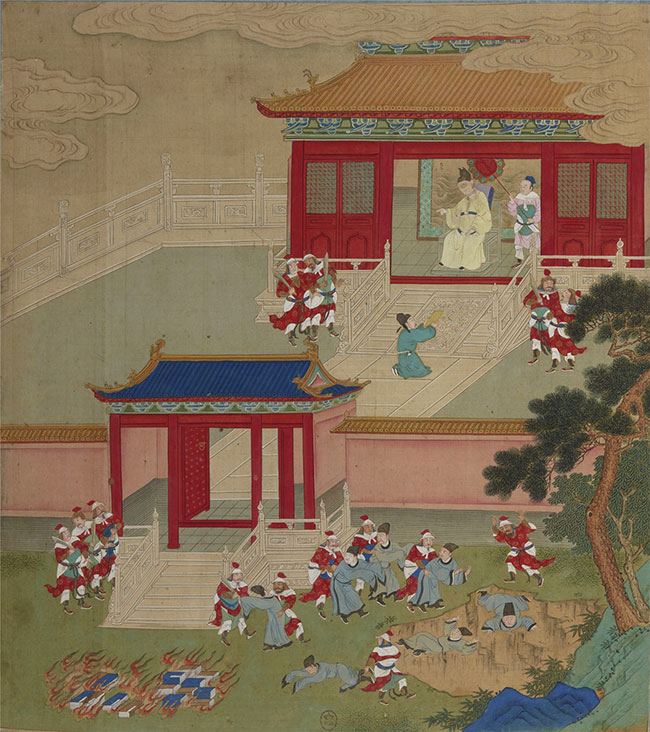
An 18th-century painted album leaf depicts events chronicled by second-century B.C. historian Sima Qian, in which Qin Shi Huangdi burned Confucian texts and hurled scholars into a pit. Bibliothèque Nationale, Paris. (GRANGER/AURIMAGES)


This interesting paper, provocative in many aspects, deals with a Comparative Study of Poetics of China and Grece, so I find it necessary to clarify some basic points on the subject. The author's decision to incorporate literature and philosophy within their definition of poetics (p. 2) may be somewhat perplexing, given that it diverges from the conventional everyday understanding and usage of the term. It is also of some importance to note that China as a cultural and political entity emerged only after the establishment of the Qin dynasty and the assimilation of distinct populations and their distinctive cultures. It is in this respect characteristic that Qin dynasty ordered a bibliocaust so as to underline the fact that the new polity would have a new identity starting from scratch! Therefore, when terms like 'nationality' and 'China' are used in reference to periods preceding this, they should be understood expansively as corresponding to a reality that was formed later, or as simply in a geographical / descriptive sense. It is worth noting that due to this aforementioned bibliocaust, written sources of (pre-) Chinese literature are of questionable dating, usually surviving through Qin and post-Qin archives, anthologies and collections! For example influential scholars like Zhu Weizheng, Michael J. Hunter et al. have questioned the traditional status of the Analects as the oldest stratum of Confucius’ teachings, while the historicity of the latter has also been disputed (Stanford Encyclopedia of Philosophy, s.v. Confucius).

In the abstract of the paper two statements are emphasized, that warrant a reappraisal:

FIRST STATEMENT

“while Western poetics came into being in the Hellenistic period ..”

This assertation is lacking accuracy. The works of the two most prominent Greek poets, Homer and Hesiod, were written down at circa the 8th century BC, but they drew upon motifs and narrations that had been orally transmitted for centuries, dating back at least to the Mycenaean era! Possibly earlier than these two Greek poets, there exists a nearly complete poem by Orpheus (Orphics – Orphica) while fragments of other epics are partly accessible through the writings of other ancient authors! It is important to acknowledge that the author revises this initial statement within the body of their paper, as on page 2, they admit that the origins of their concept of Greek poetics are rooted in what they term "ancient Greece" (500-336 BC).


SECOND STATEMENT

“Although there was no mutual communication and influence between the two kinds of poetics, due to both geographical distance and chronological displacement ..”

Between the two worlds, i.e. the Aegean and Serindia, there seem to have existed some kind of contact through migration or other means, as it is seemingly shown from the transfer of technologies, ideas and motifs. This contact was facilitated by the expansion of the Persian Empire, while Alexander’s conquest put Greece side by side to China and India from the end of the fourth century BC onwards! In this sense even the assertion of Derk Bodde (pp. 2-3):

“There are, for example, the facts that Chinese civilization, though not so autochthonous as once supposed, was founded and thereafter developed in relative isolation from any other civilizations of comparable level.”8

proves to be very conservative and outdated by as many as 70 years of research since the publication of the relevant paper at 1953! Without going intο further details, we may simply note here that between Greeks and Chinese there were even military contacts, friendly or warlike, as in the battle in Talas – Kyrgystan (36 BC), in the conflict between Han China and the Greco-Saca Jibin / Chi-pin, in the conflict with Ferghana (Dayuan – Greater Ionia) over the heavenly horses of the latter and in the conflicts between Han China and Xiongnu over the Hexi Corridor (king Xiutu as a vassal of the Xiongnu and later member of Chinese elite)! (Konidaris 2020). Yinmofu (Hermaios ?) seems to have been the first and also the last Indo-Greek king who accepted investiture from China and established a formal political relation with the Han court, while the hybrid Greek kingdom of Jibin could be admitted as a vassal state of China!

Speaking about Xiutu we may mention that this enigmatic and important figure in Chinese history was possibly of Greek descend. He had a son named Midi (Ridi), who would later receive the epithet “Golden Midi” from Wudi, the emperor of the Han (157–87 BC). According to the Hanshu, King Xiutu had his capital city in one of what were later the Han Chinese “ten districts of Wuwei”, and he has been described as a Xiongnu king by most historians. (Christopoulos 2022) According to wikipedia, wikipedia, s.v. Jin Midi, Jin Midi was born in 134 BC to a Xiongnu allied royal family probably of Greco-Bactrian origins ruling central Gansu. He was the heir of the king Xiutu (Soter/Σωτήρ), one of the major kings serving under the supreme ruler of the Xiongnu, Gunchen Chanyu. After Gunchen's death in 126 BC, his brother Yizhixie succeeded him. During this time, the king of Xiutu and another major king, the king Hunxie, were assigned for defending Xiongnu's southwestern border against the Han Dynasty – in modern central and western Gansu. This very person, Jin Midi, along with Xiutu have been the genetic founders of the famous Ban family (Sanping Chen 2011). 


Story of Jin Midi - A black and white drawing of two people sitting on a bench

According to Sanping Chen, an authority on Chinese culture and history, the family:

.... family produced not only Ban Biao(3-54), Ban Gu (32-92) and Ban Zhao (ca. 49-ca.l20), the father-son-daughter trio that authored China's first ever dynastic history Han-shu but also the extraordinarily daring and capable diplomat-general Ban Chao (33-103), who singlehandedly (reportedly with a force of only 36 fellow adventurers) re-established the Han domination in Central Asia (known at the time as the Western Regions) after the debacle under the tragicomic pretender Wang Mang (45 BC-23 AD). Chao' s exploit was further carried on by his Central Asia-born son Ban Yong.

..

The historiography of the Ban family was clearly highly influential in restoring the radically virtue-oriented, producerist and pro-peasant tenor of Confucian thought, and if Hill’s reading of the history is correct, they seem to have done it with such aplomb that it became taken for common sense in subsequent eras (Sanping Chen 2011). 

According to an interesting theory, that would explain some of the Hellenistic customs and art references existing among the Murong Xianbei, Yao Weiyuan (1905–1985) argues that King Xiutu was the ancestor of some members of the Xianbei military aristocracy too! (Christopoulos 2022). Members of this 'ethnic' group are supposed to have a long-lasting influence in China since they held prominent positions in Chinese aristocracy (Sanping Chen 1996). In this sense Greek contribution in Chinese intellectual history can be recognized as having an additional path for cultural communication facilitating cultural exchange! But the introduction of Buddhism in ancient China was another important channel for the diffusion of the artistic traits of the Greco-Indian Gandhara art as well as of the relevant religious - philosophical attributes of Buddhism.


Writing about his method of comparative analysis the author states:

“This style of Sino-Western comparative approach is termed by Wiebke Denecke as “ellipsis”2. For instance, both Cecil Maurice Bowra and Ernst Robert Curtius argue that Chinese culture lacks epic tradition characteristic of European culture3. Another frequently noted idea in Sino-Western comparative study is that “there is no tradition of tragedy in Chinese literature.”4”

The author attempts to base his views on the theory of Denecke, who makes use of the (Greek!) terms of ellipsis and catachresis in order to build another not colonial and non chauvinistic approach. This attempt in line with the rather extremist movement of ‘cancel culture’ is usually employed by members of the so-called ‘younger’ or ‘deficient’ cultures, such as, possibly, the Chinese compared to the Greek one. This reconsideration has been - with surprising sincerity (!) - recognized by Beecroft as a result of changing intellectual trends and shifts in global economic and political power (that) have contributed to a reassessment and to approaches that account for similarities and differences without assuming that the Greek tradition is superior or paradigmatic (Beecroft 2016). This changing political power balance urges the new major political players (mainly China and India) to ask for a reappraisal of the past, in line with what Mazower has stated: 

"As small states integrate into a wider world another future needs another past" (Mazower 2006, p. 554).

At this juncture, it is important to emphasize that in an age marked by political correctness, certain Western scholars felt compelled to challenge a hypothesis suggesting significant foreign influences on the so-called deficient cultures. Their motivation stemmed from concerns that acknowledging Greek influence might inadvertently lead to an overemphasis on assessing the accomplishments of other civilizations solely through the "Greek lens." (Solos 2021).


The author criticizes other scholars who have identified ellipsis (f.e. in epic tradition and tragedy) in Chinese culture. However, the author seems to conveniently sidestep addressing these particular deficiencies, downplaying their significance. Should the author wish to delve into the origins of Chinese theater and drama, it would be intriguing to explore Li Qiang's perspectives, according to which:

"Readers were surprised to discover that the traditional literary arts of China were all related to the Silk Road, where Yanshi’s puppet plays, masked Nuo plays, Buddhism music–dance plays, and religious ritual plays associated with Chinese traditional operas were bred; Sanskrit plays, highly praised in Kushan in the Western Regions, and Zhezhi plays, prevalent in the Tigris and Euphrates basins of Central Asia, shaped the patterns of exchanges between Chinese and foreign drama cultures after being introduced into the Central Plains.

..

An in-depth study may further uncover the following conclusion that such masks prevailing in the East actually originated from Gandhara art and Dionysus of ancient Greece.

..

Khotan in Xinjiang of China was adjacent to the mountains and rivers of Kushan and Gandhara, and they once shared a common destiny. Therefore, it is quite reasonable that there was a significant Hellenistic influence on performing arts and drama in Khotan."

It is also worth noting that China has never been colonized, at least not in the ancient times and especially not from the ‘usual’ western colonial powers!


Writing about similarities in Rhetoric the author states:

“Last but not the least important is the similarity in rhetoric as effective discourse shared by the scholars of pre-Qin and ancient Greece. James J. Murphy’s affirmation that “It is important to note at once that rhetoric is an entirely Western phenomenon”40 is again a chauvinistic idea.”

The author tries to access another similarity between pre-Qin, i.e. pre-China (!) and Greece, that in rhetoric (pp. 13-14). In this attempt he makes use of the The Book of Change which, according to available data (Wikipedia, s.v. The Book of Change) was initially a divination manual, that several centuries later at about the 2nd c BC was transformed to a philosophical commentary!:

.. is an ancient Chinese divination text that is among the oldest of the Chinese classics… was originally a divination manual in the Western Zhou period (1000–750 BC)… during .. Warring States and early imperial periods it transformed into a cosmological text with a series of philosophical commentaries known as the "Ten Wings".[1] After becoming part of the Five Classics in the 2nd century BC, the I Ching was the subject of scholarly commentary and the basis for divination practice for centuries across the Far East, and eventually took on an influential role in Western understanding of East Asian philosophical thought.

The author refutes J. J. Murphy’s view that rhetoric is an entirely Western phenomenon, and criticizes G. A. Kennedy who shares a similar perspective by arguing that rhetoric existed in Greece only because it was given such a name as “rhetoric” was, naming this affirmation as ridiculous! Forgetting his so impolite characterization in the following part of his study the author states (pp. 13-14):

the Pre-Qin scholars not only paid the same importance to rhetoric as an effective discourse as the scholars in ancient Greece did, but also coined the name “xiuci” the Chinese name for rhetoric)even before Plato coined the term “rhetoric.” The evidence was the famous Chinese phrase “xiuci li qi cheng” (polished expressions are to be based on sincerity)42, which appeared in The Book of Change, a book written during the West Zhou Dynasty (roughly 1027-770 B.C. The major difference between the East and the West in studying rhetoric is that “in the East, rhetoric has been considered so important that it could not be separated from the remainder of human knowledge” while “in the West, rhetoric has been considered to be so important that it has had to be explored and delineated separately, as a special field of knowledge about human relations.”43

In conclusion the said reference to rhetoric is dated at about the 2nd century BC, in a questionable and ambivalent - polysemic - ambiguous way, as Kong Yingda of the 6th c AD interprets it differently! Even if this is the case rhetoric seems much more ancient in Greece than in Qin China by several centuries!


Without proceeding to analyze thoroughly this useful and informative study I would like to give the following concluding remarks on certain of its aspects.

The view that China developed a complex society and high culture without external influence has already been proved to be inaccurate. It is now known that contact and interaction did take place, based on mobility, migration and exchange processes mainly along the Eurasian Steppe Highway and the Silk Road. Not solely via the nomadic tribes but certainly through their agency as well, said interaction included the Mediterranean and Bactria-Margiana Archaeological Complex, as well as Afanasevo and Andronovo cultural horizons. The Hellenistic civilization is shown to be a significant party in this cultural encounter, mainly through its local cultural hybrids of Greek–Bactrian and Greek-Indian polities! The use of gold and silver as preferred luxury materials and the appearance of realistic life-size sculptures are only indicative examples with a rather pronounced Greek dimension; the above, together with architecture, landscape painting, various jewelry techniques, martial arts, and so much more, all owe a great deal to the Aegean heritage.

BIBLIOGRAPHY (OF REVIEW)

https://www.academia.edu/15211511/Hellenistic_World_and_the_Silk_Road
Yang, Juping. 2013. "Hellenistic World and the Silk Road," Anabasis 4 (Studia Classica et Orientalia), pp. 73-91.

https://research-bulletin.chs.harvard.edu/2014/10/03/hellenistic-information-in-china/
Yang, Juping. 2014. “Hellenistic Information in China.” CHS Research Bulletin 2 (2). http://nrs.harvard.edu/urn-3:hlnc.essay:YangJ.Hellenistic_Information_in_China.2014

It was through the Silk Road that Hellenistic information spread into China. Although the clues in the documents and the cultural elements in the historical relics are not easily recognized, it is certain that the contacts, exchanges, and fusions between Chinese and Hellenistic civilizations actually took place and developed even long after the disappearance of the latter. Of course, most of my ideas may be just tentative hypotheses. I hope I can modify my paper in the future with the discoveries of new materials.

https://staffnew.uny.ac.id/upload/132299491/pendidikan/postcolonialstudiesthekeyconceptsroutledgekeyguides.pdf
Ashcroft, B., G. Griffiths, and H. Tiffin. 2007. Post-Colonial Studies. The Key Concepts, 2nd ed., London and New York.
Bill Ashcroft, Gareth Griffiths and Helen Tiffin 2007, p. 30

Η εφαρμογή ενός όρου σε κάτι άλλο που έτσι δεν δηλώνεται σωστά (ΟΕΔ).

Αρχικά αναφερόμενος στην γραμματική «κακή χρήση», αυτός ο όρος χρησιμοποιείται από την Gayatri Spivak με τρόπο που είναι κοντά στην έννοια της οικειοποιήσεως. Η κατάχρηση είναι η διαδικασία με την οποία οι αποικισμένοι παίρνουν και ξαναεγγράφουν κάτι που υπάρχει παραδοσιακά ως χαρακτηριστικό της αυτοκρατορικής κουλτούρας, όπως η κοινοβουλευτική δημοκρατία. Όταν η Spivak μιλάει, για παράδειγμα, για την ικανότητα του υποδεέστερου «να κατακτήσει την κοινοβουλευτική δημοκρατία» (1991: 70), εννοεί «την εισαγωγή και την επανεγγραφή, κάτι που δεν παραπέμπει κυριολεκτικά στη σωστή αφήγηση της εμφάνισης της κοινοβουλευτικής δημοκρατίας. (70). Δηλαδή, ενώ η κοινοβουλευτική δημοκρατία αναδύεται από μια συγκεκριμένη ευρωπαϊκή ιστορία και κουλτούρα, η υιοθέτησή της και η προσαρμογή της στην κουλτούρα της μετα-αποικιακής κοινωνίας, συμπεριλαμβανομένου του ισχυρισμού, για παράδειγμα, ότι υπάρχει μια προ-αποικιακή εγγενής παράδοση κοινοβουλευτικής δημοκρατίας, μπορεί να προσφέρει μια ενδυναμωτική λεωφόρο αυτοδιάθεσης στο υποκείμενο. Μια άλλη κοινή και ενδυναμωτική κατήχηση είναι η εφαρμογή του όρου «έθνος» σε μια κοινωνική ομάδα που υπήρχε πριν από τον αποικισμό, όπως π.χ το «έθνος των Ζουλού», το «έθνος των Αβορίγινων», το «έθνος των Σιού».

Li Qiang. 2019. Silk Road: The Study of Drama Culture (Series on China’s Belt and Road Initiative III), trans. Gao Fen, New Jersey.

https://books.google.gr/books?id=FbecAQAAQBAJ&printsec=frontcover&hl=el#v=onepage&q&f=false
Denecke, Wiebke. 2013. Classical World Literatures: Sino-Japanese and Greco-Roman Comparisons, Oxford.

Ellipsis: p. 13 of Denecke 2014


of false ellipses. China and Japan, and Greece and Rome, are not conceived as cultural binaries, but as long-standing constellations of cultural reception processes, of cultural translatio. Thus, when we come to compare the four literary cultures of the Ancient Mediterranean and East Asia, we are not in fact comparing cultures, but reception processes. This constitutes a double move. First, we shift from an ontological to a dialectical comparative approach — from asking, for example, "how do Japanese and Latin literature compare?" to asking "how did Japanese and Latin authors deal with the historical flatness of their own tradition vis-a-vis their reference culture's?" Also, we move from a comparative approach that results in detecting ellipsis — the absence of something that makes one of the cultures look deficient — to an approach that profits from Catachresis {κατά-χρησις, εως, ἡ, excessive use or consumption, PTeb.61(b).305 (ii B.C.), Gal.19.679. II. analogical application of a word (e.g. γόνυ καλάμου, ὀφθαλμὸς ἀμπέλου), Arist. ap. Cic.Orat.27.94, Demetr.Lac. Herc.1014.49, D.H.Comp.3 (pl.), Quint.8.6.34, Sch.D.T.p.459 H., etc.: pl., Suid. s.v. Γοργίας; ἐκ -χρήσεως Gal.6.136.}[What is the theory of catachresis? In postcolonial theory, according to Bill Ashcroft < https://onlinelibrary.wiley.com/doi/abs/10.1002/9781118430873.est0281 > <https://staffnew.uny.ac.id/upload/132299491/pendidikan/postcolonialstudiesthekeyconceptsroutledgekeyguides.pdf> [p. 30] and others, catachresis “is the process by which the colonized take and reinscribe something that exists traditionally as a feature of imperial culture, such as parliamentary democracy” (34) and either render it or transform it in relation to their own culture or ...] — the temporary application of an existing name to something that does not have one. We can get stuck in unproductive ellipsis by saying, for example, 'In Japanese literary culture the earliest literature was highly valued, so that a rich textual record dating back to the earliest period survives today; in contrast, Roman literary culture lacked that respect for its origins, which led to the loss of most of early Latin literature," Only once we apply the Japanese case to the Roman one through productive cross-application, catachresis, can we make unexpected discoveries and ask intriguing questions: as we will see, the Japanese case shows that Rome's loss of its early literature is not necessarily the norm and cannot be explained away by the assumption that early stages of literary production are awkward and simply propaedeutic for a greater future and thus "deserve" their loss. Which aspects in Roman literary culture facilitated the loss of early works? And, in catachrestic turn, which features of Japanese literary culture, if applied to the Roman case, would have prevented the loss of early Latin literature? (For the curious reader, I address these questions in Chapter 3.) Indeed, comparison should be a two-way catachrestic laboratory rather than a trial court imposing on one party the guillotine of ellipsis and cultural deficiency.

https://www.academia.edu/26847898/Ritual_Text_and_the_Formation_of_the_Canon_Historical_Transitions_of_Wen_in_Early_China?email_work_card=title&li=0
Kern, M. 2001. "Ritual, Text, and the Formation of the Canon: Historical Transitions of  Wen in Early China, " T'oung Pao (Second Series) 87 (1/3), pp. 43-91.
 
Konidaris, D. N. (Κονιδάρης, Δ. Ν.) 2020. Chinese civilization and its Aegean affinities (in Greek), 2nd ed., Αθήνα.
 
https://oxfordre.com/literature/display/10.1093/acrefore/9780190201098.001.0001/acrefore-9780190201098-e-1001
Vijay Mishra. Postcolonial Theory, https://doi.org/10.1093/acrefore/9780190201098.013.1001

http://users.uoa.gr/~cdokou/TheoryCriticismTexts/Spivak-Subaltern.pdf
Gayatri Chakravorty Spivak. . "Can the Subaltern Speak?," in Colonial Discourse and Postcolonial Theory. A Reader, ed. P. Williams and L. Chrisman, Columbia Univ. Press, pp. 66-111.

https://ttu-ir.tdl.org/bitstream/handle/2346/18601/31295017085480.pdf?sequence=1
Bih-Shia Huang. 2002. “A Comparison of Greek and Chines Rhetoric and their Influence on later Rhetoric” (diss. Texas Tech Univ.)

https://doi.org/10.2307/495377
Kao, K. 1993. Rev. of Yi Pu 易 蒲 (Zong Tinghu 宗 廷 虎), Li Jinling 李 金 苓; Yuan Hui 袁 暉, Hanyu xiucixue shigang 漢 語 修 辭 學 史 綱 [An Outline History of Chinese Rhetoric; Hanyu xiucixue shi 漢 語 修 辭 學 史 [A History of Chinese Rhetoric] in CLEAR 15, pp. 143-154.


p. 150
concerns the ethical question of rhetoric in general. Quintilian's "good man" theory, or Isocrates' stress on the importance of the moral character of the orator, could be seen as comparable to the Chinese concern as expressed in the dictum from the Yijing Mg: "Xiuci ii qi cheng" (often understood as "polished expressions are to be based on sincerity" or "polishing the expressions in order to establish one's sincerity," although Kong Yingda [6th c AD] interprets it differently). In this connection, the Socratic position against rhetoric—because of its easy appropriation by the sophists to "make the worse appear the better cause"—finds a parallelism in the Taoist mis-trust of refined language ("Truthful words are not beautiful,/ Beautiful words not truthful"— Lao Zi, ch. 81), while Wang Chong's criticism of hyperbole seems to have arisen from the same consideration.


Schiappa, E. 1999. The Beginnings of Rhetorical Theory in Classical Greece, New Haven: Yale University Press.
https://www.amazon.com/Beginnings-Rhetorical-Theory-Classical-Greece/dp/0300075901    

In this provocative book, Edward Schiappa argues that rhetorical theory did not originate with the Sophists in the fifth century B.C.E, as is commonly believed, but came into being a century later. Schiappa examines closely the terminology of the Sophists ― such as Gorgias and Protagoras ― and of their reporters and opponents ― especially Plato and Aristotle ― and contends that the terms and problems that make up what we think of as rhetorical theory had not yet formed in the era of the early Sophists. His revision of rhetoric’s early history enables him to change the way we read both the Sophists and Aristotle and Plato. Schiappa contends, for example, that Plato probably coined the Greek word for rhetoric; that Gorgias is a “prose rhapsode” whose style does not deserve the criticism it has received; that Isocrates deliberately never uses the Greek work for "rhetoric" and that our habit of pitting him versus Plato as “rhetoric versus philosophy” is problematic; and that Aristotle "disciplined" the genre of epideictic in a way that robs the genre of its political importance. His book will be of great interest to students of classics, communications, philosophy, and rhetoric. https://bmcr.brynmawr.edu/2001/2001.03.09/

https://www.jstor.org/stable/j.ctt7zvh5f
Bodde, D. 1981. Essays on Chinese Civilization, Princeton.

https://www.academia.edu/35676781/The_Formation_of_the_Classic_of_Poetry
Kern, M. 2018. "The Formation of the Classic of Poetry," in The Homeric Epics and the Chinese Book of Songs: Foundational Texts Compared, ed. F.-H. Mutschler,  Cambridge Scholars Publishing, pp. 39-72.

p. 40-41: The Records {.. of the Archivist or Records of the Grand Historian (Shiji)(Shiji) ca 145-85 BC} speaks of the Poetry as a unified and universally shared text organized by Kongzi {Confucius}; it does not yet speak of that text’s subsequent lineages of transmission or interpretation. The “Monograph on Arts and Writings” in Ban Gu’s (32-92) {of partial Greek ancestry!?} late first-century CE History of the Han (Hanshu) takes the history of the Poetry into the early empire: ..
The two passages translated here are the earliest systematic accounts of the Poetry. Both date from the early empire, that is, centuries after Kongzi’s lifetime (and following the Qin imperial unification of 221 BCE). Both are centered on the role of Kongzi not as the author but as the compiler of the anthology; and neither account indicates how the poems had come into being in the first place, or who had authored any of them.
..  had been recited [from memory] and had not merely been [written] on bamboo and silk..
p. 49: writing was not yet standardized even in Han 
..

https://neoskosmos.com/en/2018/08/23/dialogue/opinion/homer-in-the-time-of-the-zhou/
Whether by accident or design, the ancient cultures of Greece and China, though geographically at great distances from each other and politically, poles apart, present interesting parallels. One of many of these, would undoubtedly have to be surprising similarities in the foundational texts of both civilisations. Somewhere between 1000BC to 800BC, Homer’s epics, the Iliad and the Odyssey, came into being, on the extreme western coast of Asia (Minor). At roughly the same time, at the easternmost extremity of the same continent, during China’s Zhou dynasty, the seminal Classic of Poetry {Odes} were collated.

https://plato.stanford.edu/entries/confucius/#SourForConfLifeThou
Stanford Encyclopedia of Philosophy, s.v. Confucius
.. Recently, several centuries of doubts about internal inconsistencies in the text {Analects} and a lack of references to the title in early sources were marshaled by classicist Zhu Weizheng 朱維錚 in an influential 1986 article which argued that the lack of attributed quotations from the Analects, and of explicit references to it, prior to the second century BCE, meant that its traditional status as the oldest stratum of the teachings of Confucius was undeserved. Since then a number of historians, including Michael J. Hunter, have systematically shown that writers started to demonstrate an acute interest in the Analects only in the late second and first centuries BCE, suggesting that other Confucius-related records from those centuries should also be considered as potentially authoritative sources. Some have suggested this critical approach to sources is an attack on the historicity of Confucius, but a more reasonable description is that it is an attack on the authoritativeness of the Analects that broadens and diversifies the sources that may be used to reconstruct the historical Confucius.

https://warwick.ac.uk/fac/arts/classics/intranets/students/modules/ancientglobalhistory/syllabus/oxfordhb-9780199935390-e-14.pdf
Beecroft, A. 2016. "Comparisons of Greece and China," in Oxford Handbooks Online, <https://warwick.ac.uk/fac/arts/classics/intranets/students/modules/ancientglobalhistory/syllabus/oxfordhb-9780199935390-e-14.pdf> (28 Oct. 2023).

..  Changing intellectual trends and shifts in global economic and political power have contributed to a reassessment and to approaches that account for similarities and differences without assuming that the Greek tradition is superior or paradigmatic.

Christopoulos, L. 2022. “Dionysian Rituals and the Golden Zeus of China,” Sino-Platonic Papers 326, pp. 1-123.

https://www.jstor.org/stable/41928567
Sanping Chen. 2011. "Two Notes on the Xiongnu Ancestry of the Authors of 'Hon-shu'," Central Asiatic Journal 55 (1), pp. 33-41. 

ΒΑΣΙΛΕΥΣ ΖΕΥΣ / Xiutu ΣΩΤΗΡ: υποθετική αναπαραγωγή χρυσού αγάλματος με βάση αργυρά τετράδραχμα των ελληνο - βακτριανών βασιλέων: Ευθύδημος Β', Πανταλέων και Αγαθοκλής, που απεικονίζουν τον Δία να κρατά την Εκάτη (Σχέδιο του Θέμη Δερβέντζα).
------------------------------------------------------------------------------------------------------------------------------------
https://www.routledgehandbooks.com/pdf/doi/10.4324/9781315108513-23
Juping Yang. 2020. "Chinese historical sources and the Greeks in the Western Regions," in The Graeco-Bactrian and Indo-Greek World, Routledge, pp. 446-464.
.. the Western Regions which Greeks once settled, controlled and inhabited for almost three centuries.
.. y one Indo-Greek king, Menander, is referred to in the Chinese translation of a Buddhist sutra, Naxian Biqiu Jing (那先比丘經, Milindapañha in Pāli; see Kubica this volume).
.. According to W. W. Tarn and other scholars, Rong Qu is possibly the Chinese transliteration of “Yonaki” (“Greek city”). The city, then, would be Alexandria-Kapisa (Alexandria of the Caucasus). Yinmofu could be Hermaios, the son of the ruler of the Greek city.
.. Hermaios would be the first and also the last Indo-Greek king who accepted investiture from China and established a formal political relation with the Han court, and the Greek kingdom of Jibin could be admitted as a vassal state of China (on diplomatic relation between Jibin and Han China, see also Yang 2013c).
Ο Ερμαίος θα ήταν ο πρώτος αλλά και ο τελευταίος Ινδοέλληνας βασιλιάς που αποδέχθηκε την βασιλική ανακήρυξή του του από την Κίνα και αποκατέστησε μιαν επίσημη πολιτική σχέση με την αυλή των Χαν, και το ελληνικό βασίλειο του Τζίμπιν μπορούσε να γίνει δεκτό ως υποτελές κράτος της Κίνας (σχετικά με τις διπλωματικές σχέσεις μεταξύ Τζίμπιν και Χαν Κίνας, βλέπε επίσης Yang 2013c).

----------
https://www.researchgate.net/publication/355038031_Early_Interactions_between_the_Hellenistic_and_Greco-Roman_World_and_the_Chinese_The_Ancient_Afro-Eurasian_Routes_in_Medicine_and_the_Transmission_of_Disease
Solos, I. 2021. "Early Interactions between the Hellenistic and Greco‑Roman World and the Chinese: The Ancient Afro‑Eurasian Routes in Medicine and the Transmission of Disease," Chinese Medicine and Culture 4 (3), pp. 148-157.
.. It was clear that in the era of political correctness some Western scholars felt it necessary to refute such a hypothesis[5,6] because they felt that the mentioning of Greek influence could lead to viewing the achievements of other civilizations through the “Greek lens.”
--------------------------------------------
https://academictrap.files.wordpress.com/2015/03/gayatri-chakravorty-spivak-an-aesthetic-education-in-the-era-of-globalization.pdf
Gayatri Chakravorty Spivak. 2012. An Aesthetic Education in the era of Globalization, Harvard Univ. Press. 
 
https://poulantzas.gr/wp-content/uploads/2013/10/spivak_gr.pdf

Χατζηαναστασίου, Τ. . "Κριτική αξιολόγηση των θεωριών εξιδανίκευσης της Οθωμανικής αυτοκρατορίας," <https://www.academia.edu/34097547/%CE%9A%CF%81%CE%B9%CF%84%CE%B9%CE%BA%CE%AE_%CE%B1%CE%BE%CE%B9%CE%BF%CE%BB%CF%8C%CE%B3%CE%B7%CF%83%CE%B7_%CF%84%CF%89%CE%BD_%CE%B8%CE%B5%CF%89%CF%81%CE%B9%CF%8E%CE%BD_%CE%B5%CE%BE%CE%B9%CE%B4%CE%B1%CE%BD%CE%AF%CE%BA%CE%B5%CF%85%CF%83%CE%B7%CF%82_%CF%84%CE%B7%CF%82_%CE%9F%CE%B8%CF%89%CE%BC%CE%B1%CE%BD%CE%B9%CE%BA%CE%AE%CF%82_%CE%91%CF%85%CF%84%CE%BF%CE%BA%CF%81%CE%B1%CF%84%CE%BF%CF%81%CE%AF%CE%B1%CF%82> (30 Οκτ. 2023). 

Mazower, M. 2006. Θεσσαλονίκη, Πόλη των φαντασμάτων, χριστιανοί, μουσουλμάνοι και Εβραίοι, 1430-1950 (Salonica, City of Ghosts : Christians, Muslims and Jews), ελληνική έκδοση: Αλεξάνδρεια, Αθήνα.

"Καθώς τα μικρά κράτη ενσωματώνονται σ’ έναν ευρύτερο κόσμο ένα άλλο μέλλον χρειάζεται ένα άλλο παρελθόν". Κοντολογίς παραδέχεται ότι κατασκεύασε ένα άλλο παρελθόν της Θεσσαλονίκης το οποίο ουδέποτε υπήρξε στην πραγματικότητα, αλλά το οποίο είναι απαραίτητο για να ταιριάζει κουτί "στο άλλο μέλλον" και στον άλλο ρόλο για τον οποίο κάποιοι προορίζουν τη Θεσσαλονίκη στον "ευρύτερο κόσμο", όπου τα "μικρά κράτη ενσωματώνονται"... Σε διάστημα μικρότερο της από το 1990 η μεσοβαλκανική ζώνη έχει κατακερματισθεί σε μικρά θνησιγενή κρατίδια αλληλοϋποβλεπόμενα.... Η βαλκανική σκακιέρα μένει ανοικτή στους δύο Μεγάλους Παίκτες».

Μαζάουερ, όπ. π., σ. 554. Ομολογείται δηλαδή πως πρόκειται για πραγματική αυτή τη φορά «κατασκευή» του ιστορικού παρελθόντος που νομιμοποιείται να γράφει ό,τι νομίζει πως εξυπηρετεί καλύτερα συγκεκριμένες σκοπιμότητες και προθέσεις του παρόντος που επιχειρούν να καθορίσουν και να ελέγξουν το μέλλον.

https://www.jstor.org/stable/41931010
Sanping Chen. 1996. A-Gan Revisited - The Tuoba's Cultural and Political Heritage," Journal of Asian History 30 (1), pp. 46-78.
p. 62
80. .. (or Ma Heluo), a colleague of the famous courtier Jin Midi of Xiongnu Xiutu origin, hence quite possibly of non-Han origin too. See HSh 68.2960-61 and ZZhTJ 22.743-44.

p. 46: The rise of Tuoba Gui led to the hardening of the North -South partition, which in turn led to the eventual absorption of the South by the North. Alas, from the Sui era onward, 60 to 70 percent of those who were prominent in their times have been descendants of the Tuoba [and other Xianbei and Xiongnu groups]!1
This long-lasting influence is also exemplified by the name Tabgach, generally considered a metathesis ...

Christopoulos: An interesting theory that would explain some of the Hellenistic customs and art references existing among the Murong Xianbei comes from the work of Yao Weiyuan (姚薇元1905–1985). He argues that King Xiutu was the ancestor of some members of the Xianbei military aristocracy.100

https://citeseerx.ist.psu.edu/document?repid=rep1&type=pdf&doi=ddfa36d2b4a92cb19611512d30e8f256514232bb
Zürcher, E. 2007. The Buddhist Conquest of China. The Spread and Adaptation of  Buddhism in  Early Medieval China, 3rd ed., Leiden.

p. 266
King Wen had grown up among the Western barbarians; the Hun Jin Midi 金日磾 had once saved the Han dynasty.77 {77 Jin Midi was the son of the Hun chieftain of the Xiuchu 休屠; he became a court official and was greatly favoured by emperor Wu. In 88 BC he saved the emperor’s life by striking down the courtier Ma Heluo 馬何羅 (whose surname was posthumously changed into Mang 莾) when the latter was about to enter the emperor’s bedroom with a dagger. Jin Midi was ennobled as a marquis in 87 BC and died shortly afterwards. See his biography in Hanshu 68.20b sqq.}
p. 325
30 Colonies of foreigners, named after their place of origin, existed already on Chinese territory in Former Han times. Thus the chapter on geography of the Hanshu mentions a Yuezhi Dao 月氏道, one of the twenty-one prefectures (xian) of Anding 安定 commandery, in present-day Gansu (HS 28 B.5a), and a Qiuzi 龜茲 Xian in Shang 上 commandery (Shanxi) (ib. 6a). According to all commentators, these were settlements of Yuezhi and Kuchean immigrants (although these Yuezhi may have belonged to the “Small Yuezhi” of Western Gansu [NEXT PAGE IS 326] rather than to the “Great Yuezhi” who after their trek around the middle of the second century BC had settled in Bactria). See also P. A. Boodberg, “Two notes on the History of the Chinese Frontier”, HJAS I (1936), pp. 283–307, esp. pp. 286–291 for Qiuzi Xian in Gansu and an “Aqsu” in Shanxi, and H. H. Dubs, A Roman city in Ancient China (The China Society, London 1957) for a possible “Alexandria” (驪靬) in central Gansu (cf. Hanshu buju, large edition, 28BI.16a). It is no doubt due to the presence of such early Western immigrants that some faint but unmistakable traces of Buddhist influence are to be found in early Han literature and art.
Chavannes (Cinq cents contes et apologues vol. I, pp. xiv–xv) has already called the attention to the occurrence of Buddhist themes in Huainanzi; another remarkable example in the  field of art is the representation of two six-tusked elephants on a bas-relief from Tengxian 滕縣 (S. Shandong) which probably dates from the middle of the  first century (cf. Lao Gan 勞幹, “Sixtusked elephants on a Han bas-relief”, HJAS XVII, 1954, pp. 366–369; picture of the relief ib. and in Corpus des pierres sculptées Han, Beijing 1950, vol. I, pl. 113). Of course the influence may have been very indirect, and the occurrence of such themes does not imply any knowledge about their Buddhist provenance and original significance.

https://www.oxfordbibliographies.com/display/document/obo-9780199920082/obo-9780199920082-0167.xml
Lisa Raphals. Sino-Hellenic Studies, Comparative Studies of Early China and Greece

https://www.jstor.org/stable/20789893
Tanner, J. 2009. "Ancient Greece, Early China: Sino-Hellenic Studies and Comparative Approaches to the Classical World: A Review Article," The Journal of Hellenic Studies 129, pp. 89-109.

https://www.euppublishing.com/doi/pdf/10.3366/ccs.2021.0389
Beecroft, A. 2021. Rev. of G.E.R. Lloyd and Jingyi Jenny Zhao, Ancient Greece and China Compared, in Comparative Critical Studies 18.1, pp. 95–121.

p. 97: Jeremy Tanner’s essay on ‘Visual Art and Historical Representation in Ancient Greece and China’ {https://discovery.ucl.ac.uk/id/eprint/1505848/1/Tanner_visual_art_and_historical_representation_in_ancient_greece_and_china.pdf} similarly derives an intriguing argument from a methodological innovation. Tanner examines artistic representations of historical events in the Stoa Poikile in Athens and in the Wu Liang Shrine, in what is today Shandong province

https://core.ac.uk/download/pdf/159146695.pdf
Weber, R. 2013. "A Stick Which may be Grabbed on Either Side: Sino-Hellenic Studies in the Mirror of Comparative Philosophy" Int class trad 20, pp. 1–14.

https://summer-schools.uoc.gr/greece-and-china/

https://en.m.wikipedia.org/wiki/File:Story_of_Jin_Midi.JPG
The story of Jin Midi. Wu Liang Shrine, Jiaxiang, Shandong. 2nd century AD. Ink rubbings derived from stone-carved reliefs as represented in Feng Yunpeng and Feng Yunyuan, Jinshi suo (1824 edition), n.p.

Jin Midi 金日磾 (lived 134–86 BC) was born a prince of the nomadic Xiongnu, a confederation of Central Asian tribes that once dominated the eastern Eurasian Steppe. He was captured by Han-dynasty Chinese forces and made a slave who tended horses in imperial stables. However, he gained the trust of Emperor Wu when he thwarted an assassination attempt against him. When Emperor Wu lay dying at his bedside, he designated Jin Midi, Huo Guang, and Shangguan Jie as regents to rule over his Liu Fuling, then crown prince and later Emperor Zhao of Han. Jin Midi thus became one of the top officials in central government.
Date 2nd century AD
Source Lillian Lan-Ying Tseng's "Mediums and Messages: The Wu Family Shrines and Cultural Production in Qing China," in Rethinking Recarving China's Past: Ideals, Practices and Problems of the "Wu Family Shrines" and Han China (London and New Haven: Yale University Press and Princeton University Art Museum, 2008), page 279.

https://faculty.ucr.edu/~raphals/pubs/2018Human%20and%20Animal.pdf
Lloyd, G. E. R. and Jingyi Jenny Zhao. 2018. Ancient Greece and China Compared, Cambridge Univ. Press.

ΠΛΕΟΝ ΠΡΟΣΦΑΤΟΣ ΕΜΠΛΟΥΤΙΣΜΟΣ - ΕΠΙΜΕΛΕΙΑ: 041123